



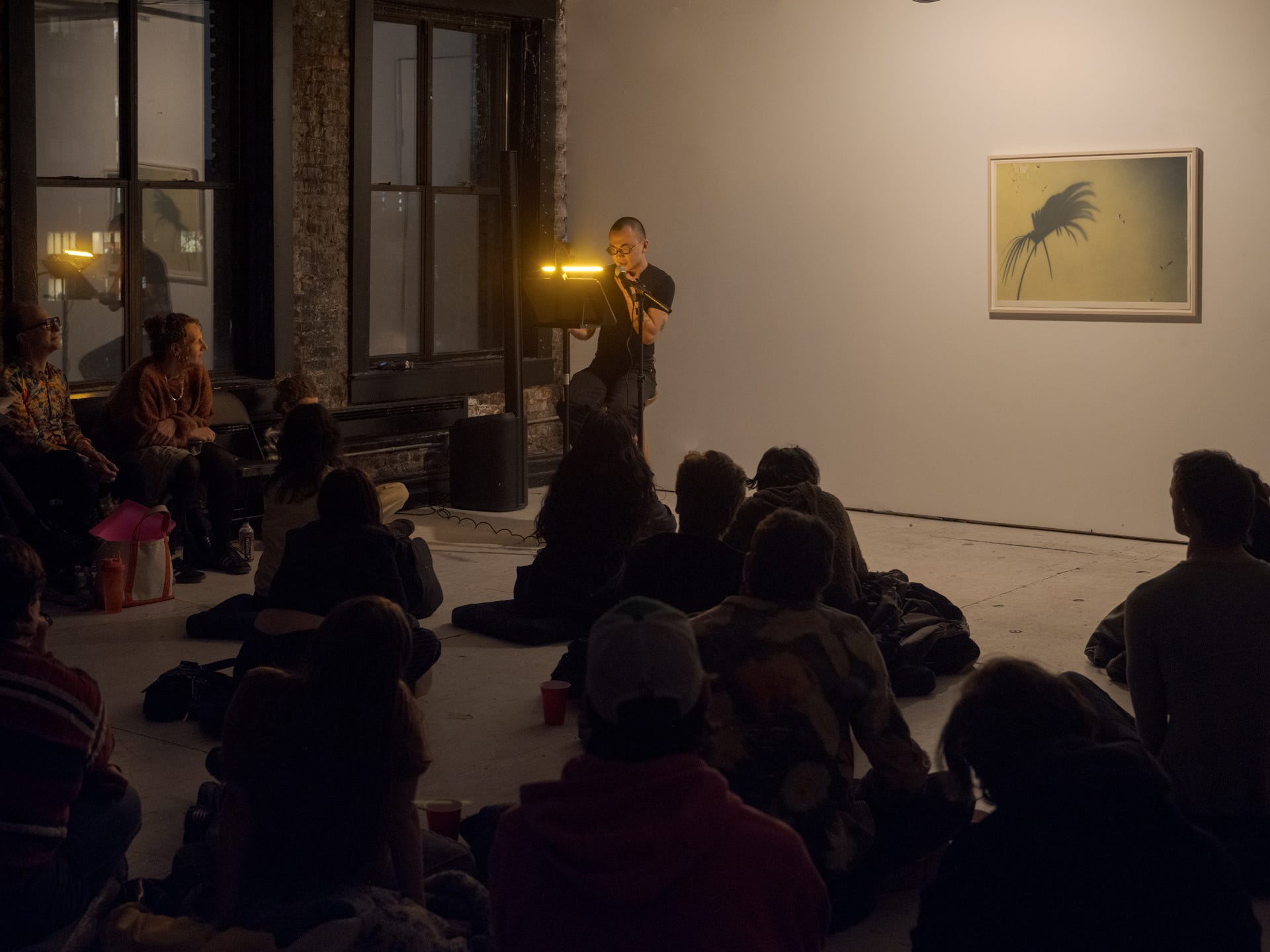
FEB182026_Works Abundancies II, curated by Juf at 99Canal, brought together Ching Ho Cheng’s 1982 artwork Untitled (Palmetto) and texts by the poets and writers Wayne Koestenbaum, CJ Craig Jun Li, Nora Treatbaby, and Ramona Ngin.
The transcript below was delivered by artist “CJ” Craig Jun Li for the occasion of the event, in response to Ching’s artwork.
Selected quote
I believe that the true continuous substrate for analog film has always been dust. The dust that appears in strobes of projected lights between the light source and the screen stays with us and seeps into us whether we see it or not. When I look closely at Ching Ho’s windows, many of which are varying shades of blue, I’m reminded of these thoughts. There is something extremely materialist about his approach. These works were made by dispersing pigment in tight definition evenly across a surface.
“CJ” Craig Jun Li
Note: This transcription was prepared for accessibility purposes and lightly edited for clarity. Bolded sections reflect editorial highlights.
I work site-responsively as an artist, so I wrote this text after the invitation in response to Ching Ho Cheng, or his Chinese name 郑庆和. I was shown his work first via this exhibition I saw last year by the invitation of a really good friend of mine. So, this piece of writing is in the form of a letter directed to him.
Dear Kyle,
It is snowing outside. I believe you are still on vacation in Mexico. I hope the sun has been treating you well. I don’t feel its warmth very much nowadays. Every winter in the city I think to myself that my body would still remember the roughness required to deal with the cold from my time in Wisconsin. That’s wishful thinking. I hop around puddles like a wet rabbit, I have to wear two layers of socks which make me feel like a cosseted baby. I think of the silhouettes of passersby on the street, wrapped in scarves and winter clothes to be completely and utterly cartoonish. Going out for a quick smoke nowadays is like volunteering to be tortured. The other day I read this beautiful sentence John Ashbery used to open an essay, he wrote: “like Paris, New York is always ready for its close up” and I thought, total bullshit. What I have learned about myself in the winter months is that I feel cruel, miserable, and sluggish. I’ve been somewhat procrastinating writing this piece that I plan to read at the event I told you about, in front of Ching Ho Cheng’s work. The more I look into his life and oeuvre, the more I’m scared of writing about him. Perhaps there are too many parallel trajectories. The other night I just complained to you about not feeling Chinese enough. I think he felt similarly. It’s kind of funny that Bea and Leto invited me to participate in this. As always, I think the best collaborators are friends, who just know things will work out, because there’s this instinctual faith that certain hidden threads will emerge over time. They were right, because I had already seen the show at BANK last year with you, when they had a temporary space on Elizabeth’s. The first time I worked with Bea was through another curatorial project she did with our friend Alberto named Yaby. They reached out to me kind of out of the blue for a visit over Zoom then later invited me to participate in a performance festival they were programming in Stockholm. At the time, my conditions weren’t conducive for me to make the trip, so we decided to present a project that works with my absence. Instead of working with performers or offering a score, I came up with an installation strategy that came out of my ongoing obsession with Felix Gonzalez-Torres’ written documents, which were pretty much the operating system behind most of Felix’s open-ended installations. The particular piece I worked off of was a light strings work titled “Untitled” (For Stockholm)” from 1992, which, as the written contract dictates, must have exactly 504 light bulbs of a certain wattage range linked together in 12 parts. What I did was rather simple, I had people working on site at the festival decide what would be the most suitable type of light bulbs that could be easily bought from any local hardware store, then had the team order exactly that amount of light bulbs to the performance space. The bulbs were displayed as freshly delivered goods in the changing room area, alongside takeaway postcards I made. On top of the postcards were photographs of light bulbs I encountered in New York City that I felt would serve the selection standard of Felix. I wanted to interrupt and interpret his score without reaching any degree of fruition. I was pondering in speculation what exactly he thought was “for Stockholm”. Despite all the Felix contracts openly inviting collaborators and collectors to make decisions about how to install his works in his absence, the foundation never keeps records of varying install strategies over the years or any list of variation of materials used. I thought that the only concrete thing he literally did “for Stockholm” was to offer light that’s not even necessarily needed. When I look up photo documentation of his light string works in general, the first thing I notice is the lack of shadows. Since most of the time these works are installed in well-lit standardized institutional spaces with white walls and fluorescent tube lights, the strung-together bulbs themselves often seem dim in comparison, and often appear more yellow or orange. In my memory viewing the lights in person, their brightness has always seemed polite. I don’t recall turning my head around to look for my own shadows in front of Felix’s lights. Looking at installation images, where the standard is to always document artworks when there’s no people in the gallery, I find it hard to imagine silhouettes of viewers forming shadows in front of these works. I feel as if it’s almost like he designed the installation this way, that we could navigate the lights closely but they don’t index us onto another plane. Our bodies bear witness to the glows while being with it in real time. There is no need to keep the record.
I tell you this because I think it somehow led me to my thinking about Ching Ho’s work, in particular the palmetto gouache drawings. I’m trying to picture myself standing in front of the work at 99 Canal, where the readings will take place. If I were to look at the work and place myself in relation to the imaginary perspective constructed by Ching Ho masterly on what seems to be a picture of a flat wall, I’m immediately placed in a triangulation with the surface and the light source. I’m looking at the shadow of a tree outside of the picture, where I’m standing, conjured via some sort of directional light, the source of which is also beyond my reach. It seems like he left some other clues. There are cracks of wall paint peeling off slightly, revealing a white ground. There are little nails and pins on the wall, often isolated individually, alongside their dramatically elongated shadows. The gentle gradation of the gouache surface suggests the general angle from which the light comes in. Still, we don’t get to see the light, and we don’t get to see the tree. If I turn around and face the work with my back, which I imagine will be the set up for the reading, perhaps what appears beneath my feet are my shadows. In this configuration the general direction of me and the palmetto’s shadows align. What greets me, however, is the reality of the present, marked with the artist’s absence, where the shadows and lights he painted still remain.
When I went to the BANK show I was mesmerized by his window works, also gouache on paper and follow a similar logic. In those works, instead of palmetto trees the lights are implicated via gridded window openings. I think of them as portraits of his days contained temporarily on his walls. For that reason, despite at first glance each picture seems more geometric and abstract, I felt my experience looking at them in sequence was actually more easily placed within the interior or even the domestic. With the palm trees it’s harder to locate the site of my looking. Where would I be standing in this room and where is this room located in relation to the palmettos? Why is there always only one branch being implicated? Where is the rest of the plant? Many questions follow.
The other thing that I noticed at the exhibition was that the ratio of a lot of the window works evoke popular formats of photography and cinema. The scales go from something like a 4 by 5 photograph ratio into something like a 70mm. Perhaps I read too much into this because, as you know, I have an ongoing collection of photographs of Derek Jarman’s Blue (1993) being screened on different occasions. In a way every time that work gets projected it’s always a slightly different blue, especially in documentation and reproduction. When I look at Jarman’s film I notice the grains of celluloid frantically bumping against each other. They tell me what I’m staring at is the record of another time when the world was preserved in a different resolution. Each grain reminds me of lives lost during the height of the AIDS crisis, the impact of which directly resulted in Jarman’s deteriorating vision and the construction of Blue.
I believe that the true continuous substrate for analog film has always been dust. The dust that appears in strobes of projected lights between the light source and the screen stays with us and seeps into us whether we see it or not. When I look closely at Ching Ho’s windows, many of which are varying shades of blue, I’m reminded of these thoughts. There is something extremely materialist about his approach. These works were made by dispersing pigment in tight definition evenly across a surface. They appear as tiny pictures of individual grains of dust. I remember standing very closely to his works and looking at the surface texture, not quite sure if the structure I’m identifying belongs to his application or to the paper. It’s like he directly fused light onto his substrate, from which glows bounce around and soften my vision. Ching Ho’s windows make me think about the sun, which remains the same yesterday and tomorrow in the sky, but the blues in our lives change everyday. We are constantly altered by light, allowing us to see or not.
If I close my eyes now and let myself go somewhere else on a tangent, I return to the register of language. First: I’ve been following down the rabbit hole of David Rattray’s writings, whom you told me was a friend of Ching Ho’s. I think originally Bea and Leto considered including a work they collaborated on as part of the reading display, but that work ended up being not feasible for the occasion. Starting in the mid-80s Ching Ho started making works by composing torn pieces of painted paper next to each other. According to his companion, the art historian Gert Schiff, Ching Ho came about tearing up his substrates as a working method after frustratingly destroying a drawing he thought was unsuccessful. I find this gesture to be significant because it’s almost like he wanted to highlight a total reveal of what’s underneath his marks, which until that point have been somewhat preciously constructed, like the gouache works. I’m also reminded of those peeled details of his walls that subtly accompanied the lights and shadows in his room. Now the openings are taking center stage. The work that was not included in the final program was a work in which Ching Ho copied Rattray’s lines of poetry onto two sheets of torn paper. The two sheets only barely touch each other at one point on the bottom edge down the middle of the picture plane, creating a crevice in the shape of an inverted triangle, a gap. When I saw a photo of this work the first thing that came to my mind was Marianne Faithfull’s 1979 album Broken English. Literally, what the work presents is the English language broken up, yet still legible and functioning. In her comeback hit new wave song Faithfull repeatedly asks the question “What are you fighting for?”. And I think with his works Ching Ho would have been asking something similar, and I have an instinct that what he was fighting for was a relationality to freedom that lies beyond the picture.
I should also mention to you that Marianne Faithfull was born on December 29, 1946, which makes her three days younger than Ching Ho and also a Capricorn born in the year of the dog. Very important Intermission. It also just so happens that, instead of individual music videos, Broken English was accompanied by a short film composed of three songs on the album, directed by Derek Jarman. On the album cover Faithfull covers her forehead with her right arm folded over, holding a burning cigarette in her hand. The black and white photograph was rendered in a deep blue hue. In his feature on Ching Ho published in ArtForum in 1986, Schiff mentions specific references in an earlier work of Ching Ho’s “The Astral Theatre”, in which he articulates that the Taoist Chinese philosopher Chuang Tzu was embodied as a tattooed man character conceived by the British tattooist George Burchett. I think I understand why Ching Ho was drawn to this figure. He exemplifies an element of Chinese philosophy that is the diametric opposite to being literal. In his dreams Chuang Tzu dreamed of existing as a butterfly. And after he woke up he embodied the experience of being a butterfly.
The character by Burchett has symmetrical markings on his face evocative of makeup used in Chinese opera. I think what he was doing there with the symbolic figure was not to reduce it to a distinctively specific reference but a portal, summoning a range of vastly different source materials altogether across the universe. I realize that I’m essentially doing the same thing in my head as I think about his works. During my research I read somewhere that Rattray actually described Ching Ho as a “sage” too. In 1988 David Rattray was suggested by an editor that he should take his version of Friedrich Holderlin’s Pindaric Fragments (1803) to a journal of German studies. In Rattray’s translation, the Holderlin versions of the fragments are in italics and his amplifications in roman. According to Rattray, the person who helped him elucidate the often deemed difficult German text was none other than Gert Schiff. I found a passage of this collaborative translation work to be relevant. Titled “The infinite”, this passage reads like the following:
Whether to scale the lofty battlement of justice
Or that of humped deceit
And so overstep my own boundaries
Is a thing I am of two minds
About going into precise details on.
The sage will have his jest, one might also say the riddle ought not be solved. The wavering, the struggle between justice and common sense can be resolved only on a continuum, a thing I am of two minds about going into precise details on.’ That I should then uncover the link between justice and common sense, itself ascribable to neither of the latter but a third factor by means of which they are connected by infinitely precise detail (the infinite) is a thing I am of two minds about.
Language keeps rambling in me. I find there to be a familiar place in Ching Ho’s name. His family name Cheng is written with the same character used in Mandarin for the name of my home town Chengchow, which was the capital of the Shang dynasty during which craftsmanship revolutionized and popularized bronze-casting techniques. When I went to the local museums as a kid, I was mesmerized by the green patinas that grow over the bronze surface of ancient objects, which survived thousands of years of being buried. These objects were not discovered or seen for a long time, but their appearance kept changing from alchemical material exchange happening underground. My parents worked as conservators for the provincial museum, and often took me on their research trips in nearby cities. Many times we visited my grandmother’s house outside of Luoyang, a couple miles away from the Longmen grottoes, which translated to “grottoes of the dragon gate”. Ching Ho was attracted to the grottoes he saw in Turkey on a trip he took in 1981, the same year some of the palmettos drawings were dated. Afterwards, he worked on a body of alchemical works made by mixing iron and copper oxide with gesso and paper to create textured pulps that could then be directly installed onto walls. At this stage, the substrate of his work transformed from support for illusions to the very structure of the work itself. When I look at images of these works, the similarities between the sculpture surface of the pulp and the formation grottoes are built upon emerge immediately, but instead of rocks and stones, Ching Ho’s surfaces seem to be oxidized and rusting. I’m also reminded of the smell, the smell of blood. In the past when I worked with iron oxide pigments without wearing a respirator, I always ended up having the smell of blood stuck in my nose long after, but I was not bleeding. My blood floats underneath my skin, it is embedded within the substrate of my flesh, remaining invisible.
When I looked up pictures of grottoes in Turkey I noticed a drastic difference between them and the ones I visited as a kid. The grottoes of Longmen house thousands of statues of Shakyamuni Buddha and his disciples, making the grottoes also a permanent, public display of Buddhist art. There are as many as 100,000 statues within the 2,345 caves, ranging from 1 inch to 57 feet in height. Since the Second Sino-Japanese War, which dislocated my family from the south to the north, many different parties have looted the statues during periods of political unrest. I was told by my grandmother that, since the statues were carved on site, most of their bodies are directly attached to the cave, making any attempt to remove the statue in whole challenging. As a result, the most common parts of the statues that were taken away were their heads and hands, as the neck and wrists would be the most fragile parts of each statue. In the pictorial sense, without head and hands, the figures can’t see, smell, hear, taste, or touch. Their senses were all taken away. In the instances where smaller statues were looted entirely, the grotto that housed the figure becomes empty, becoming inhabitable again, this time with visitors taking tourist pictures, or with children playing hide and seek. In absence of the sacred, our bodies enter the picture. When the sun rises, the grottoes become the most dense areas where shadows appear, sometimes in the shape of a pondering saint, sometimes in the shape of onlookers, and sometimes in shapes that evoke fragments of the mountain itself. The shadows project into the grottoes, indexing what’s no longer and what’s right exactly here, like a photograph.
I shall return to the palmetto for a moment. Whether there was a tree outside of Ching Ho’s window is really not a question that concerns me. What I keep trying to think through is why he chose to put a branch there, as this disembodied, almost phantom like shadow. And I still don’t have an answer. What I do know is he made this picture to offer us a very special perspective, between a site unknown and a light unknown, a domestic limbo. As I stare at these pictures for an extended period of time, I feel I’m becoming more sensitive to the light in space, the light behind me, the light outside, the light above us all, the sun.
Besides the interviews he gave, I couldn’t find much of Ching Ho’s own writing. When I write about someone, I also try to think of how they wrote. Despite English being my second language, my Chinese is no longer very coherent, especially in writing. I noticed that in some of his works Ching Ho would stamp Chinese characters as a signature. I wonder if he felt any distant affection for the same language as I do. I came across an introduction Ching Ho wrote to a book of poems by Gregory Millard, who was his lover at one point I believe. This piece of writing also serves as a kind of eulogy, as Millard passed away at the age of 37 in 1984 due to AIDS related illnesses, and this collection of poems was published posthumously. In her cover of the song “The ballad of Lucy Jordan” from Broken English, Marianne Faithfull sings “As she lay there underneath the covers, dreaming of a thousand lovers, until the world turned to orange and the room went spinning round. At the age of 37, she realized she’d never ride through Paris in a sports car, with the warm wind in her hair. So, she led the phone keep ringing, and she sat there softly singing little nursery rhymes she’d memorized in her daddy’s easy chair.
Towards the end of Ching Ho’s introduction, he quotes a poem by Millard 7 years before his passing and the beginning of onset of any fatal symptoms: “There is not enough time/ I feel death struggle/ determined to caress me/ with a sigh/ “we were meant to be /lovers”.
Like many of my forefathers, my English has always already been broken. Yet I feel determined to speak, to listen, to write, especially towards people I love. I think at any moment, when one’s shadow begins to emerge, we are all equal underneath the sun. Except that some of us are more determined to believe what lies beyond every picture is a world of lies refusing to be captured. I hope you have a safe trip back home. My heart is with you always.
CJ
“CJ” Craig Jun Li (born 1998, China) is an arts worker and artist based in New York City. Li’s work has been shown in solo and group exhibitions, including Emmelines, New York; Galeria Filomena Soares, Lisbon; lower_cavity, Holyoke; KW Institute for Contemporary Art, Berlin; Kurtkubin, CDMX; SYSTEMA, Marseille; François Ghebaly, LA & New York; Taon, Ivry-sur-Seine; ROMANCE, Pittsburgh; Chris Andrews, Montréal; RAINRAIN, New York; September Sessions, Stockholm; hatred 2, New York; Prairie, Chicago; and Canal Projects, New York, among others.
Li operates a nomadic curatorial project, “Benny’s Video,” currently hosted in a studio sublet in Bushwick.
Juf is a curatorial and research project focused on contemporary art and poetry that organizes exhibitions, performances, readings, and online and printed publications. Directed by Bea Ortega Botas and Leto Ybarra, it is now based between New York and Madrid.
99Canal is an artist-run Studio & Public Program located in Lower Manhattan, New York City. As a 501(c)(3) nonprofit, we support artists through access to professional studio environments and present an open, research-driven curatorial platform for public engagement.


