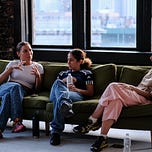
Selected quote by 99 Canal’s team:
I think I try, every two years, I try and switch up my game quite drastically. Whenever I feel as though I’m getting comfortable or confident with the way I’m working with something, it feels as though a way in which making the work feels perfunctory. Part of making the work for me is to just feel as though I created a problem that just feels kind of out of my control, and the process of making it feels as though I’m just trying to solve that problem.
Simon Liu
22MAY2025 SHOCK STUDIES_a new expanded cinema performance by Simon Liu. Featuring an intricate network of analogue projection, handmade electronics, live sound, and reflective materials, the work examined the problematics of nostalgia, representations of prohibited spaces, and the boundaries of control within an increasingly automated world.
In this conversation, artist Tiffany Sia and filmmaker Simon Liu discuss Simon’s expanded cinema performance Let’s Talk, contextualizing it within the sociopolitical transformations in Hong Kong since 2019. Liu reflects on themes of estrangement, memory, and control, shaped by his inability to return to Hong Kong during the protests and pandemic. The work departs from direct political documentation, instead using abstraction and formal experimentation to convey affective dislocation.
TRANSCRIPTrecorded on 21.05.2025
Tiffany Sia Um, first of all—you lied to me. You said, “Sometime in the evening,” and I thought, like any reasonable human being, that meant six o’clock. Then it was, “Oh no, the performance starts at nine, because it gets dark at nine.” And now—where are we? We’re inching toward ten. So you’re getting a very different version of me right now. So this is going to be way, way more casual. Hong Kong time.
I'm a morning person. I wake up at like six, six thirty, how dare you take me away from my bed?
[laughs]
Simon Liu I’m very sorry…
TS No, but really—I’m honored to be here and excited to be in conversation with you. The first time we met—we talked about this on the phone—we tried not to get into too much of this ahead of time, but it was actually in Hong Kong back in early 2019. That was before the protests had begun, roughly five or six months before?
SL Yeah, it was January 8, 2019.
TS Which is really weird that you remember the exact date.
SL Well, you know, our dear friend (taking a video right now) was in Hong Kong at the time, with another friend of ours. And I met you that day—I flew back to New York two days afterwards, and I remember this being this very important day in my life in a lot of ways, because the next time I went back was when the protests had started, and so many things had started to change.
TS Did you shoot Signal Eight then?
SL Yeah, I was shooting it then. I just remember that June 8, 2019 was really one of the last days where there wasn't all of this, you know, this baggage of what had happened that was hanging over everything. I mean, it's such a beautiful day, and that June 8, 2019 will always stick with me in that way.
TS Yeah, I remember that really clearly. Josh (in the audience) was doing a residency at this space I was running—Speculative Place. I don’t think you ever ended up going, but I had found this random house in the outer part of Hong Kong, and Josh was staying there and shooting with a gas mask on because he was paranoid about the smog. Justifiably so, I should say, it was very smoggy. But yeah, I just wanted to link Signal Eight to this work, because I see it very much in that trajectory. I'm kind of curious to talk to you about that, because it's sort of an exploded version of Signal 8. But I don't get the sense that this work is about Hong Kong anymore, and I kind of want to talk to you about what that might mean.
SL Interesting. Yeah, so the film that's playing right now is called Let's Talk, and it was filmed in June of 2022, leading up to the 25 year anniversary of the handover. And so, you know, the last time I went there to Hong Kong was in November of 2019 and, you know, I wasn't able to go back because of COVID and because of travel restrictions. And so it felt like there was this way in which, like, returning to Hong Kong, after all these things had changed… I was asking.
I think at that time, no one really knew how to socialize, or how to just be a person that's communicating with other people in the world. And so going back to Hong Kong, after all this had happened, there was this feeling of estrangement, this constant kind of leery eyed feeling. And so that the film Let's Talk, kind of documents this feeling of like reemerging to a place after it's become increasingly unfamiliar, but also just like this kind of personal realignment with exterior life and, you know, what does it mean to see a place that has been… so I felt attached to in so many ways.
TS But there's something very specific though, about the announcement, that's like a public service announcement in repetition at the beginning of the performance that I was kind of interested in hearing you talk about. There's also that very specific British accent… And
SL I think that's mainly just, like, memories of growing up in Hong Kong in the 90s. You know, I remember there's all these, like, commercials about what you get from falling ACs. And, like, I don't know, there was this feeling in which, in which there's public service announcements. There's a very particular tone to those broadcasts.
And so it felt as though they weren't needed, probably as loaded as the current kind of broadcasting from the government. So my sister's voice here replicates the affect and that kind of tone. I think it's this idea of this lingering sense of control. What does it mean for that language to have shifted over time in a way?
TS Can you talk a bit about shock studies? You began the performance by saying, shock, this is shock studies. I forget exactly what you said.
SL Shocked. Um, well, the joke, or kind of not so unserious joke, it's like a controlled electrical hazard…
TS Did you shock yourself in the process of faking it?
SL If you put your finger on the line, place there is an open voltage in three different areas.
TS Cool
SL Everything's off now, so everything is safe. Don't worry. Um, but I maybe should have prefaced that, inviting people to shock themselves…
I did a performance a few years ago where I took an older work called "Harbor City" and plugged two different fans into a power strip, and, just like, activated the fans to change the speed of them over time. And so there was this, there was this feeling. I tried to make these customizable fans that, like, would change the rotation with a dial, and that just felt way too finicky. And it felt too techy, in a way. And so there was something really gratifying about just like, turning a power strip on and off, and just like, see the like, this very gestural result of just like, I'm doing this here, and then things are changing drastically over there. And so for the past three years now, my mind's been going through, like, oh, what else can I plug into these power strips? You know, like, what is this kind of activity that could happen through creating a network of power strips that are plugged into one another? I think we all learn that you're not supposed to do that…
TS I think Shock Studies should be renamed Fire Hazard, because I don't think it's just like the danger of shocking.
SL So well, this is Shock Studies beta… So there's a whole series to create this network of power straps and this network of connections between different voltages, and different actions of turning things on and off through just a single gesture. I was really interested in trying to bold off of that, to create some kind of schematic that would almost fall out of my control, to build a scenario in which I have a very particular idea of how everything is networked together. But there's a way in which that schematic is almost too complicated, or too difficult to keep up with. So the act of kind of performing the work is to tend the ground, to try and synchronize the projectors, to try and find a way to keep up with something that's like, a little bit over my head, or kind of falling out of my grasp in a way. Yeah, I don't know, I would generally make things way more complicated than need to be… And that's kind of my MO here.
TS Cool. I think I also led you into the technical question, because there's also a part in which you are talking about the political situation, and the emotional aspects of the political situation that are so searing for me that I was just trying to avoid it. And it's very hard to actually have a real conversation about those things in a public context.
We've had some private conversations around that, but it almost feels like the way in which you've created the mapping of this, like ground circuitry, if you will. And this weird daisy chaining of power strips as this kind of haphazard, paranoid, overwhelming, slightly dangerous thing is also this way of also mapping out a kind of paranoia that is so much part of the works formally, as they are structurally and through the techniques of electricity and projections and things.
Again, I'm deflecting some of the more searing parts of talking about the situation into talking about the technical components and the formalistic aspects of the work. But I think that that is also so much at play, um, yeah, cause I don't think that it's really easy to talk about those things. We can explain things vis a vis the National Security Law and get very specific, but then there's also this aspect of the return to January 8, 2019, when we met, and it was a really deeply different time. And so there's something also so much about the work is about these endless loops, time loops that you've caught us up within and then overlaid them against one another, and then also expanded them against different surfaces. And what is your obsession with overwhelm? What is that? Are you trying to overwhelm yourself, other people? I mean, I heard from Rachel that you stayed up until 7:30 in the morning putting this together.
SL No, you know… I think, in part, we live in a time where, like, we are so inanimate with images and ideas, and we're constantly acclimating to keeping up with all of that. You mentioned signal eight before, and away from Hong Kong, when all these things were unfolding, there was this way in which I was in New York at the time, and I was detached from the physical location of being there, but I think about what does it mean have this information, to have this like sense of change be transmitted to you through a device. And you know, things happen so quickly over the span of a year and a half, you know, like less than that, you know, like within it, within a year.
I've always thought about upbringing, I was a lot out of control with a lot of family dynamics. The sense of trying to, trying to like, acclimate myself to being in a situation where everything feels okay, everything feels like the way that they are, the way they should be, is extended to work in many ways. I think there's this kind of alignment between my upbringing and the way that, like, the city that we love, has changed so much, and that's totally outside of our control. But also, you know, the way in which we can't really keep up with how quickly things are changing and we live in this world that's increasingly automated. Um, automated and there's this way in which I want to engage myself with trying to create a structure and a working practice and methodology that is outside of my control. And what does it mean for the human, the human hand, and the limits of what someone can really do to control something and to test that. To create something that almost slips out of your hands, and then the process of making a work is to try and find a way to keep up with that in a way.
TS I'm going to check the time, because I want to leave some time for audience questions. I feel like this might be a good transition. Audience questions…
Audience I'm a bit of a rambler, as you both know, but things that come to mind in this space... I mean, having seen your work, Simon, and thinking about the way that you sort of take your single channel work and then translate it into a space. I've seen at least three or four different versions of Let's Talk alone … I’m thinking about the way the memory works, of revisiting a thing again and again. Abstraction has its uses in office, political obfuscation, but also just in a formal sense as well.
Looking at the panning projectors, I'm made to think both of was it the Greeks who believe that vision came out of your eyeballs, rather than light coming in toward you, as well as, obviously security cameras and surveillance, but also they're like for DJ lights, and so it makes me think of like surveillance rave, also watching you operate during your system shock, I found myself thinking that you, in a way, had created your own kind of infrastructure with these recordings of announcements, and you're flipping the electrical system on and off.
In a way, it felt like there was a paranoid or anxious overwhelm, but also a kind of weird DIY electrical utopia, that you were creating your own system. I don't know, it also felt kind of hopeful and a kind of floppy electrical fire way, yeah. I mean, I'm biased, but I guess Simon, is there a point where you feel like you constantly are rediscovering new configurations of ways of transforming your work. Or do you ever feel like you hit a point where you've exhausted something and that it cannot then be refragmented into a new figure or into a new form?
SL Oh, what a wonderful question. What does that mean? Um, yeah. I think I try, every two years, I try and switch up my game quite drastically. Whenever I feel as though I'm getting comfortable or confident with the way I'm working with something, it feels as though a way in which making the work feels perfunctory. Part of making the work for me is to just feel as though I created a problem that just feels kind of out of my control, and the process of making it feels as though I'm just trying to solve that problem. And you know, when the working method feels like it's hitting the point of diminishing returns, I know I've completed a work in a way…
But this is the first expanded cinema piece I've made in the past eight years now, and so I don't know, I think these expanded cinema works were the first pieces that I would share around, um, and I'm like starting to realize that returning to a prior working methodology, returning to the electric utopia, in a way, is something where there's a cycle. My therapist when I was 21 once said that life happens in seven year cycles. And I think that's actually kind of true. I just remember seven years ago, where was I at then (?) and so I wonder if there's this way in which returning to a similar working method again, after a certain amount of time where I've changed, where so much of the world has changed, it feels almost more (like) productive or interesting to me, to kind of approach my practice in that way. To leave behind what was working, and to then return to it later on, to settle back in to see, how can I lean back on those methods that worked before? How can I kind of expand on them? How can I shift things off in a way? But, yeah, thank you so much. I loved your thoughts on it.
Audience Hi can you talk a bit about how you use sound during the performance, please.
SL So on top of the 4, 60 mm projectors that are in the back, they're plugged into these fancy power strips called relays. So when a voltage is sent to the side of them, it basically switches from one outlet to the other outlet. So every time I flip one of the sub power strips and make it so one projector turns off and the other one turns on. And so this kind of flip flopping between the four, is produced by using these two power strips. On top of the projectors, there are these. He made electronic devices called photosensitive resistors. And so whatever a projector turns on, no signal passes through the cable when they're in darkness, but as soon as they're illuminated, the signal is allowed to pass through, and so basically this act of turning the projectors on and off activates the sound over time.
I felt there was this way in which I was kind of finger drumming, and I was interested in this. I mean, I think with expanded cinema work, a performance work, there's, you know, there's this beauty, but issue at the same time with misalignments between sound and image. And so I was interested in trying to find a way in which the activation of the projectors could also activate the sound at the same time.
And the sound sources; there's like samplers, there's a synthesizer, there's like my voice that's running through it. Um, I think sometimes there's this kind of conflict or tension between the sound and the image, you know, between the content, the atmosphere, the mood, but then it kind of snaps into line based on the rhythmic qualities of the way in which they're being switched on and off. Yeah, I don't know. Like, again this is shock studies beta. So I'm wondering if there's other ways to keep expanding on this in a way.
Audience So one impression that I have is that you always are very generous about kicking out the technical aspect of the thing. So my question is, what is going on without film? Like, what is going on? Did you use an optical printer, or did you reshoot the thing? Like, what?
SL So that piece is called Cluster Click City Sundays. And it's actually a re-reworking of an older, expanded cinema work. So the three pieces that the three multiple projector works that are being shown are just like reconfigurations of older material. And so, basically, each of the camera negatives were multiple times exposed in camera, and then I ran them through a contact printer, and then exposed them. And each contact print, each run of the contact print, basically had a different filter on it. So there was this cyan and magenta trace.
And, you know, like thinking back about that, that was also a system and a system and a schematic where, like everything, a lot of the working methodology was very much out of my control. And working in that way, you make mistakes, you realize that, you know you wasted $100 by pushing the button in the wrong way, or like, turn the light on at the wrong time, and so… but at the same time, through mistakes and through, through kind of moments where you feel like things are slipping out of your control, something emerges in those moments. And so I'm interested in finding a mistake, but then finding an interest in a mistake, but then not just showing the mistake to like see what happened through that coincidence, and try to rework it, and try to expand upon something that happened by chance, to kind of arrive at a piece that I always intended to make through spontaneity, in a way in process.
Audience Just to piggyback off that comment. So, do you make mistakes on purpose?
SL Um, I think if working in a very like half hazard kind of way, I think the mistakes are bound to happen. The mistakes themselves aren't the purpose, but through the approach of making work in an improvisational and kind of risky manner, they naturally are just gonna pop up. And so, yeah, I don't know, there's that kind of nervous energy around the feeling of the potential of the mistake, but then also, as a result, I feel as though I have to double down and try and work it even harder in a way. I don't know, I think we keep talking about this idea of the process slipping out of your control. And so, yeah, I think there's a lot of overlap and different ways in which that can align.
TS Maybe I'll just close out with just one question, what does it mean for you to take your work from a sort of more traditional cinematic space into a space like this? You know, other spaces in which you can kind of enliven this expanded cinema. What does it mean to go from one kind of context to another?
SL Yeah, I think of cinema as a place where there's like a beginning, a middle and an end. And I think there's something that's beautiful about this fixed attention, about the pure darkness, about this way in which something starts at a certain time and ends at a start in time. I was doing these expanded cinema works, and it would take so much time to set up, and there was a lot of labor that went into it, but I'm really interested in trying to find a way for like the work to kind of live on loop, for like images to do be re examined, to be scrutinized, to kind of find a way to reinterpret what they might mean over time.
And as I think we've, kind of discovered, in so many ways, the images that we're encountering about Hong Kong and considering my relationship to the place, our relationship to the place, things keep changing over time, you know, and I think I'm interested in trying to find and to work with a method where there is opportunity to reflect and to repeat viewing.
There's something about that that's much more conducive in an installation setting, I don't know, yeah, and there's something about working in a space such as 99 Canal, where so much happened in a very improvised way. There was a way in which I had a very set plan, and, you know, I had to kind of respond to what was happening and respond to, you know, the mistake, there's things that don't work out exactly as you intended. Like, originally this projector was going straight into the kitchen, and then the perfect way of, kind of resolving that is to just put a mirror in front of it, you know, and that created kind of the outline as this dinosaur eyes floating above us right now from the mirror I'm talking about. Um, through those limitations, and through not a limitation, but through trying to problem solve, something else emerges in a way.
TS Well, thank you so much, and thank you all for staying for the Q and A! Yay, Simon!
SL Thank you so much, Tiffany. It's been such an honor to be in conversation with you. Yeah. And thank you for being and staying up past your bedtime.
TS Thanks for having me.
SL Also… I'd like to thank a bunch of folks. I'd like to thank Rachel, who helped out immensely to make this happen. Producer, you're the best. Um, I'd like to thank Phil, if he's still here somewhere, my constant love and support. Um, I'd like to thank Baldassarre for having us and for this incredible space 99 Canal. It's one of a kind. It's magical. And I'd like to thank Zach, who's not here, for so much guidance and for building the resistors for me as well. So yeah, thank you so much. Guys. Thank you.
Speakers:
Simon Liu (b. 1987) is an artist filmmaker whose practice centers on the rapidly evolving psychological and sociopolitical landscapes of his homeland of Hong Kong through material abstraction, speculative history, and subversion of documentary cinema practices via short films, multi-channel video installations, mixed media prints, and 16mm projection performances. His work has been exhibited at institutions including the Whitney Biennial 2024, Museum of Modern Art, MOCA Los Angeles, The Shed, PICA, Tai Kwun Contemporary, Museum of the Moving Image, Everson Museum, Moderna Museet, "Dreamlands: Expanded", and the M+ Museum. His films have screened at festivals globally including the Toronto, New York, Berlin, Rotterdam, BFI London, Edinburgh, Jeonju, and Hong Kong International Film Festivals alongside the Sundance Film Festival, New Directors/New Films, CPH:DOX, Cinéma du Réel, Punto de Vista, Viennale, and the Media City Film Festival. The M+ Museum and MoMA recently acquired Liu’s Quadruple 16mm Projection Highview, along with other recent works, for their Permanent Collections. He is currently editing his first feature film, Staffordshire Hoard.
Tiffany Sia (b. 1988) is an artist, filmmaker, and writer. Sia's films have screened at TIFF Toronto International Film Festival, New York Film Festival, MoMA Doc Fortnight, and elsewhere. She has had solo exhibitions at Artists Space, New York; Maxwell Graham Gallery, New York; and Felix Gaudlitz, Vienna. Sia is the author of On and Off-Screen Imaginaries (Primary Information, 2024), a compendium of essays that makes a case for fugitive, exilic cinema, moving beyond national identity and the politics of place as a critical lens. Her work has been included in group exhibitions at Museum of Modern Art, New York; Fondazione Prada, Milan; Seoul Museum of Art, Seoul and elsewhere. Her essays have appeared in Film Quarterly, October, and more. The recipient of the Baloise Art Prize in 2024, Sia has given talks at Dia Art Foundation, Stanford University, Yale University, and has taught at Cooper Union.
The artist and filmmaker’s work at its core challenges genre. Working across mediums, her multidisciplinary practice materializes across multiple forms from films, video sculptures, artist books, scholarly essays, and more. Sia's work blends nonfiction with prose and theoretical inquiry. Her formal explorations confront questions about the representation of place, relating especially to memory and the imaginaries of exceptional and irregular polities beyond the national (from Hong Kong to elsewhere). Throughout, her conceptual focus remains in the struggle to represent historical time, geography, and the limits of official records. Sia currently lives and works in New York.
5x5 is an annual series we organize for artists and curators working primarily across performance and film, offering a platform for dialogue, the presentation of live and experimental works, and the sharing of in-progress projects directly with the public. For this year’s edition, we are reimagining the format as a series of five public conversations, each featuring two to four participants. These discussions aim to foreground pressing concerns within the participants' current research and practices—ranging from representations of shifting imaginaries of political space in film to the use of improvisation in performance art as a critical and strategic method.
About 99 Canal
99 CANAL is a project run by artists, for artists. As a 501(C)3 non-profit, our studio program and public program seek to amplify artist perspectives and promote equitable access to studio spaces and experimental art practices in the heart of Chinatown, New York City.
With a strong emphasis on film-based media and performance, our public program actively supports experimental practices while offering our local audience unique opportunities for engagement through participation and long-term reflection.
As an artist-run space, we intend to make 99 Canal a hub where impactful forms of art are nurtured, presenting ambitious projects outside of current New York City canons. The public programme is currently funded by our close community, and is access free to the public.
Website
https://99canal.net/#


