

studio program_Mira Schor
January - March 2026

We’re delighted to introduce Mira Schor as 99 Canal’s most recent Studio artist. She has been working out of Studio 2 where she created a new body of work currently presented in her solo exhibition Mira Schor: Figures of Speech at Lyles and King open till March 28, 2026.
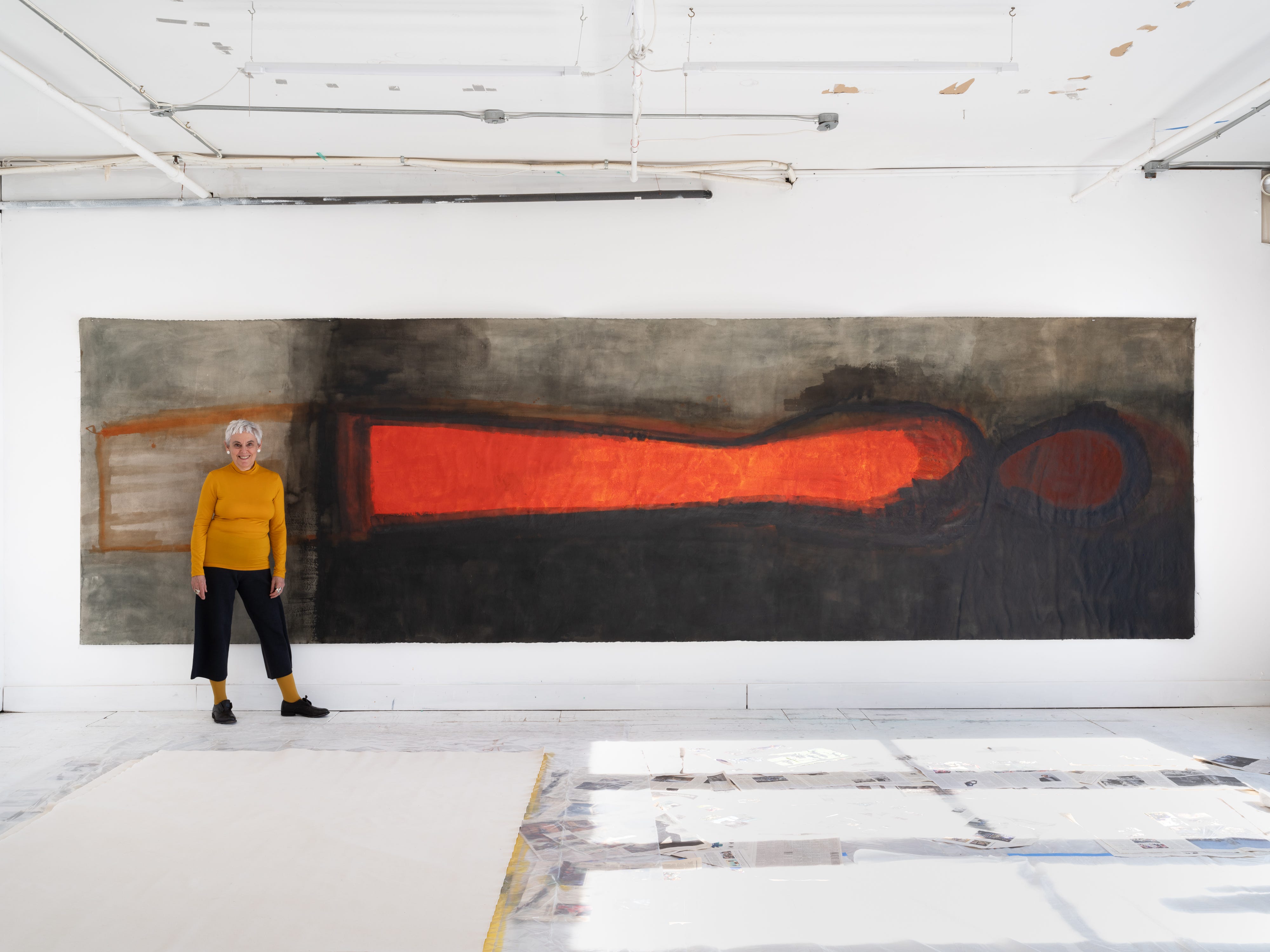
Operating in the nexus of language, painting, and feminist theory, Mira has continually imbued formalism with political urgency, and reminded viewers that written discourse and physical form are inherently linked.
Mira shares a personal essay coming from an assignment she would give out as a professor, in which she encourages students to “fail” as a creative exploration. Through this gesture, she critiques the institutional and ideological structures that suppress experimentation in contemporary art education.
The essay was written for Draw It with Your Eyes Closed: The Art of the Art Assignment, published by Paper Monument in 2012.
FAIL!
By Mira Schor
I usually give the assignment sometime in November, middle of the first semester. I issue something between a permission and an order: you have my permission to do what you think would be a really bad artwork. I give a limited time frame, usually one week. I give you my permission to fail for one week, or maybe less: I give you the order to experiment for just two hours, take two hours out of your life to do what you think is a bad work, to do something out of your habits or comfort zone, without fear of judgment.
You have my permission to fail.
No one has yet followed this advice anywhere near to the letter. Sometimes I get emails during the week asking technical questions about, say, conservatorial concerns, what if I use this material and this happens, in essence asking my permission to do this or to do that experiment. After all, what if the failure should fail?
There are structural/institutional reasons and aesthetic/ideological ones why I give this assignment and why it seems to be nearly impossible for early 21st-century MFA students to fulfill.
Educational institutions (I’m speaking here of the United States at least) are increasingly corporatized in their organization, goals, and language. The utilitarian and public (as well as the declarative and spectacular) are emphasized over the speculative or private. This can affect the kind of creativity that doesn’t work on a metronome or a meter.
The corporate atmosphere of educational institutions is usually not fully transparent to the student, yet it is part of the infrastructure for the economic stresses they face: student loans, job and art market pressures. In that geopolitical/economic matrix, it is no surprise that the schedule of the traditional two-year mfa Fine Arts program is as rigidly timed as a military quadrille. Speaking as a participant, I can say that this is necessary in order to pack as much real instruction and experience in as possible, but it also ensures the appearance of instruction and of money’s worth.
Between the first few weeks of sheer shock when students experience an overwhelming exposure to a bewilderingly vast amount of diverse new artists, ideas, theoretical languages, art styles, aesthetic and political criteria (many of these contradictory), and the pressure in the second year to come up with a streamlined package of thesis work, there are literally only a few weeks in the two years when experimentation can take place with some knowledge and some momentary freedom from expectations.
Students are expected to produce work regularly for critiques and discussion with teachers and visiting artists. This is why they have come to graduate school, but, in this atmosphere, it is unfortunately also the case that doing work whose meaning you might not have a ready explanation for, work that is transitional, even work that is a “failure,” is a terrible risk.
This enforces the current dominance of intentionality. Even though many art faculty still express a mid-20th-century rhetoric of experimentation and discovery through studio practice, there has been a radical shift in the past thirty years from the mix of formalism and subjective expressionism that characterized art education in the wake of Abstract Expressionism, to a type of conceptualism that, at least on the surface, seems to reward rationalized concordance between visual appearance and verbal articulation, a to b. An artist today is unlikely to start a work without knowing exactly what it’s going to look like and to mean. Appropriation and sampling give you the basic elements; a catalogue of tropes and recipes provide methods and styles for their assembly. Students are encouraged to research the subject of their work, consider their audience, and have all elements in place before they proceed to execute the work accordingly.
Here Walter Benjamin’s conclusion to his 1928 essay, “Post No Bills: The Writer’s Technique in Thirteen Theses”—“The work is the death mask of its conception”—should be a cautionary precept. Benjamin’s interest in the “unintentional truth” carried within the dust and debris of early consumer capitalism reminds one that a contemporary artist’s intentions cannot determine what mark of its time the work will ultimately carry into the future, intention notwithstanding.
Here the artist’s encounter with (an expanded notion of) materiality takes on new importance, transforming the linearity of intentionality. Experimentation with time, chance, language, even research, as well as with traditional media, can bring the artist to an expression that tells the artist something beyond the already previsualized, audience-tested, executed idea. Some works of course require planning, but even then the task of the artist is to be extremely alert to his or her own reaction to elements that may seem like surplus in terms of the initial intentional program but feel the most alive, however illogical at first glance. Political art is often criticized as didactic, even when it’s only meant to be accessible to a targeted audience. Perhaps that’s because some (though not all) “political art” works may neglect the unexpected power that can be released by something seemingly peripheral to a political or didactic program: a color, the angle of a shot, the small gesture of a performance that speaks volumes, in an allusive poetic register. Even just for a nearly imperceptible moment, a work must be allowed to become unmoored from its initial premise.
To get around the rigid confines of intentionality and self-commodification, I have another assignment I’ll just sneak in here, another path in the same direction as Fail! To help students to access the unknown within themselves, I ask them to write a detailed description of the visual appearance of a work they would never do, to convey through language both the work and the reason they would never do it. I always say, you’ve already pictured something the minute I said this. What did you picture? The result, often enough, is a description of an interesting work that they obviously should try to do. Here language has been the experimental path to an extremely important realization for an artist: that what you dislike passionately is in part something that is within you.
Finally, writing the present essay, I thought about one other possible assignment. I’ve never tried it, and in the current system, it would perhaps be radical to the point of insubordination. Since necessity is an ineffable yet crucial factor in what makes a work interesting, this assignment would be to experience the world but NOT make any art, for an hour, a day, a month, a year. You do not have my permission to make art. I forbid you to make art.
What creativity might erupt from this suppression?
Artist bio:
Operating in the nexus of language, painting, and feminist theory, Mira Schor has continually imbued formalism with political urgency, and reminded viewers that written discourse and physical form are inherently linked. Her work has included major periods in which gendered narrative and representation of the body have been featured; in other periods the focus of her work has been representation of language in drawing and painting. Mira draws on multiple sources of imagery and art historical reference to inform her paintings. The central theme in recent work is the experience of living in a moment of incipient fascism, climate collapse, and accelerated time, set against the powerful pull of older notions of craft, and visual pleasure.
Studio Program | 99Canal
Our Studio Program facilitates four private, professional studios (350–800 sq ft), offered to artists of all disciplines through three-month residencies. We’ve found that individuals developing personal projects in New York, engaging with our neighborhood, and proposing initiatives for our public programs tend to gain the most from the residency. During their time at 99CANAL, artists are invited to take part in community-driven activities such as our ‘in conversation’ series, recurring lunches, and open studios.