MAY MAKKI X nasa4nasa: promises
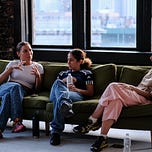
01AUG24 Following nasa4nasa’s performance “promises” at 99 Canal, dancers Noura Seif Hassanein and Salma AbdelSalam engage in a conversation with May Makki surrounding their practice.
In this conversation, the Cairo-based performance duo nasa4nasa (Salma Abdel Salam and Noura Seif Hassanein) reflect on their practice, which began in 2016 as an Instagram-based response to limited access to performance spaces in Egypt. Their early experiments with short-form, site-specific videos evolved into durational, spatially engaged live works such as SUASH and promises, with a consistent emphasis on improvisation, relationality, and environmental responsiveness.
They discuss how built environments act as a “third choreographer,” shaping both aesthetic and conceptual concerns. The conversation also introduces their current research-driven project, Sham3dan, which critically engages with the gendered and colonial histories of Egyptian dance traditions.
Throughout, they interrogate the shifting relationship between digital and embodied performance, emphasizing a desire to return to spontaneity within increasingly institutionalized and archival frameworks.
“We didn’t know that this would become a piece. It was just a score we gave each other in rehearsals to just connect. And the more we did it, the more we felt like it served how we were feeling. We started it in October, I think, so it was really this moment of just taking a breath, allowing things to happen, being slow, being connected—and this idea of really grieving. We felt like we needed some space in the studio to just grieve, yeah, and together, and alone, and grieve the current, and grieve the past, and just sit with it for a minute..”
nasa4nasa
TRANSCRIPTrecorded on 04.08.2024
May Makki I want to thank 99 CANAL for being such great hosts, and also colleagues at BOFFO who were very collaborative with sharing nasa4nasa while they were in town. Thank you to them. And, of course, Noura, and Salma, thank you so much for being up for doing this and for sharing promises again in New York City.
nasa4nasa Yeah, thank you. Thanks for having us.
May Makki So, I know people here have different levels of experience with your work. Some people might follow you on Instagram, some may have caught some of your recent performances here. I think it’s helpful to back up to 2016 when you started nasa4nasa as an Instagram account. Can you take us back to that time? How did you start that? Why did you decide to start working in that way?
Salma Abdel Salam I'll start. (laughter). So we've been friends for a very, very, very, very long time since we were six. It varies, because there's an age difference, but like six-ish and we studied dance together at the Cairo Contemporary Dance Center and we had chemistry. We had a very similar background and movement and like language, movement/language. And then at dance school, it kind of really clicked. And in 2016, after each of us had done some things, we decided we wanted to work together, not knowing what it would be. So we just said, let's set up an Instagram page. It's low risk, low cost, low everything, low commitment, and let's start just dumping stuff onto Instagram and just see what will happen. Also, we weren't sure how to access the dance stages or the spaces that were kind of closed off or non-existent or shrinking because of the political situation.
Noura Seif Hassanein We also wanted to create images and short videos that fit into the Instagram account. So initially we started as an Instagram account. We started creating for Instagram, and it was very visual in the beginning. We were attracted to functional spaces, and how we move in functional spaces, and how to collaborate with spaces. So a lot of very staged images in visually appealing spaces. In 2016 Instagram was very different than now.
May Makki I was looking at your timeline on Instagram. It started in 2010 and then video started in 2015.
Salma Abdel Salam Exactly, and stories in like.. 2019, 2020, something like that. So, yeah, I wonder if there were stories about how we would have done it because then we were also limited to one minute. So we'd really like, go into a space and be like, Okay, we have one minute to figure something out. Sometimes the video would be 10 seconds, sometimes up to a minute. Sometimes we'd slow it down, glitch it. So we were also interested in using that medium.
May Makki To back up, for people who didn't read the little paragraph. You work and live in Cairo, which is where you were working at the time, in 2016. For people who aren't familiar, like, what were the dance platforms like, for showing your work, at that time?
Noura Seif Hassanein There was one festival that used to happen every two years, which is still happening. And two theaters, and at that time, one of them had shut down. So it was really getting very claustrophobic because it's a very tiny scene, and we didn't have access to studio spaces or theaters. So it was very limited in a sense, especially in 2015-2016.
May Makki So you were making these performances for Instagram for a few years before SUASH, which was a major live work that you presented. I experienced it online, not in person!
nasa4nasa (laughter) it was major.
May Makki You performed it in a squash court, but maybe you can talk about how you moved from making these 30-second and one-minute dances to this more extended work. I think it was 30 minutes, and you presented it for a live audience, rather than recording it for an online audience.
Salma Abdel Salam It was the squash court. I think it was the squash court that decided, or like, we entered the squash court thinking, we'll do another round of Instagram posts. And by then, we were also very like, let's go there. Let's go there. You get very, kinda hyped up by it, so it was exciting. And then we entered there and we're like, Okay, we need to pause. We need to really work on it and do it justice. So we spent almost two years.
May Makki Were they like; What are you doing here? Why are you dancing in the squash court?
Noura Seif Hassanein They were like, these two women that come practice yoga in a squash court! (laughter) They didn't get what we were doing. But then the moms were pissed off that we were taking time off their practice.
Salma Abdel Salam It was a gorgeous space… this grid was like a painting, and we just felt very... we paused and we said, No, this is not going to be like a three-second video. This is going to be a 30-minute long performance and it was very challenging to move in that space in the beginning. That's why it took us a really long time because nothing worked. It was very dominant as a space. And...yeah, we found ourselves satisfying a grid or romanticizing the space. And it was a very long process of collaborating with that space and we used to call it our “third choreographer” because it was so present with us in the whole process.
May Makki I re-watched it, of course, and there's a certain way that you're moving in sync and very slowly. There are some parallels with this score that you were showing, but yeah, there's a lot more. Like, angular...
Salma Abdel Salam Very linear. It's very strict, very calculated, very demanding. It was also very challenging in terms of not failing because if you fail, you fail the squash court. In a way, it was a weird tension of wanting to get it 100% right all the time. Whereas here I feel there's more permissibility to see what happens if something fails. So I think it was because of the space.
May Makki So that work SUASH, which you first presented in a squash court in Cairo. I know you went on to perform it in various festivals around the world, where then they drew like a squash court on stage or something like that. It seems like in that case, the context of Cairo was really important, and that you felt like when it traveled, maybe something was…
Salma Abdel Salam It also had a very specific language. It was very form-oriented. We were wearing these onesies, red tight onesies, and it was a choice, and we were aware that it was playing on very modern dance, like Merce Cunningham. But it was also not just an aesthetic choice, it was about what would serve the squash court. So when we traveled and showed it elsewhere, the language became the most dominant. These two brown bodies that are using a very white, American, 1940s-50s language sort of thing. It worked, but it just worked differently. It felt very political in Egypt because of the space, because of the time, because of its slowness, because of its persistence, and a lot of layers adding onto that.
Noura Seif Hassanein I also think, going back to the language, that we were attracted to form and beauty and what that would serve, and the skill of the linearity of the movement, and it was also like an aesthetic choice.
Salma Abdel Salam Yeah, for sure.
May Makki So you feel like people overread into it, the modernist values, or something like that?
Salma Abdel Salam I think people wanted to make it political in any way, but in ways that didn't hit for us. So we did, like this one gesture in Vienna, and someone was like, oh, women’s liberation, and you're reminiscing and thinking about the Egyptian revolution, whereas it was really about matching the lines of the squash courts and giving ourselves that permission and that time to really think of form and think of beauty and think of time. So it just hit differently..
May Makki I like what you say of the space being the “third choreographer” and I feel like that was especially true with your Instagram work, where you were going into these different sites or public spaces and commercial spaces. And this work, promises, that you now performed here, I think this is the fourth time that you've done it, but in very different spaces. Over the weekend, you performed it on the beach on Fire Island. I know it's an improvisational score too. So, how do you feel that it’s shaping?
Noura Seif Hassanein It was very different in the previous location, especially with the ocean. It was very informative. So again, it was very informed by the space that we were in, and we had to adapt it differently because we had performed it in a gallery space before, and then in an open festival, which was also different. So we keep adapting it and playing with the duration of it. Do you want to add anything?
Salma Abdel Salam So the title, promises, I think, is what really captures what we are trying to do in this piece. So every time, it’s a new promise, or a new attempt to promise something, and then maybe it succeeds, maybe not. And this, trying to be with each other in time, trying to care for, or allowing each other to kind of move alone, but then also creating that kind of field that moves together. So I think what’s interesting for us is really going back to that initial thing, trying to find that promise again and again and again. It keeps changing every time, and, like any promise, it can fail or it will fail eventually. So there’s something very beautiful about that difference every time.
May Makki Well, I'm sorry I made you describe it again (laughter). You gave me five sentences a few days ago of the description, but I thought I would read it. I know you're still developing language around this piece, but maybe it's helpful.
Slow and taught movements that negotiate distance, tenderness, appearing, and disappearing. This work is a constant to exit the passage of time, to move into being within time. A promise in its essential structure is always deemed to failure yet predicated on hope, possibility, and potentiality. The absence and anticipation of a fulfilled promise is a testament to a lack, a desire projected onto the other, never to be achieved, impossibly fulfilled. You long for a body that you have grown attuned to and in the process, project onto bodies lost or grieved. In “promises” nasa4nasa’s motions and choreography embody the making of an awaited promise, a synchronicity that constantly breaks, a repeated insistence to capture time as it fleets.
nasa4nasa Yes.
May Makki I have a new question, actually. I know that so much of your work initially was around synced movement between you two, but in this score, that's not exactly the case. Maybe you're following each other, responding to each other. Was there a point at which you changed the objective of the way your bodies morph together?
Salma Abdel Salam I think it was always there, but I think it was also about really playing with a duo, and the idea of twinning and the potential of also morphing into each other in a way. Sometimes we watch a video and we’re like, “Is this me?” “Is this you?” And that fluid vision was very exciting and interesting. But there was always…it depended on the piece. But we have some moments where we try to form something like a symbiosis or something that does this together. This time, I don’t know. Do you feel like it was a conscious decision?
Noura Seif Hassanein It was building throughout our practice. I felt it was seeping in. Because it was very harsh and unforgiving to stay synced. Like, we’re also not professional dancers, in context. We’re not trained to be, you know. We went to school in our late 20s. We’re not that trained, so it’s really impossible to find this, you know. It’s like, insane. So I think we just wanted to breathe, and this improv score is very nerve-wracking, but also, it gives you a lot of surprises and breaths.
Salma Abdel Salam I think the process itself was what we really went into. We didn’t know that this would become a piece. It was just a score we gave each other in rehearsals to just connect. And the more we did it, the more we felt like it served how we were feeling. We started it in October, I think, so it was really this moment of just taking a breath, allowing things to happen, being slow, being connected—and this idea of really grieving. We felt like we needed some space in the studio to just grieve, yeah, and together, and alone, and grieve the current, and grieve the past, and just sit with it for a minute and with someone. So I think it was also that urge to not go into the studio and be like…and to just sit.
May Makki You explicitly call out this desire around promises and the language that you're building. And I felt so much that’s a thread running through your work, from Instagram and thinking of that platform, and showing your body on that platform. But then also, in this recent work, No Mercy, that some people here may have seen, like the icon you shared with me, the equivalent of the siren of the Nile, the temptress who lures in the man to kill him! And now, here, you're exploring it in a different way. So I just wanted to think about that too…how this is something that’s taking different forms in your work… Since you mentioned what you’re working on next. I know that you're working with a cast of dancers for your upcoming piece. Tomorrow you’re flying to resume intensive rehearsals. Would you like to share more about that work?
Salma Abdel Salam Can I add something about desire? I think when you work as a duo, or maybe as a trio or quartet. Because we work so much together, and because there’s a lot of intimacy in our work, there’s friendship, and there’s layers of everything, years and years and years. I think desire becomes the “third choreographer” also. The idea of how we can continue to relate, continue to find openings where we can meet each other again, and continue to become different people throughout the process. So I think that part in between is what's always brewing. Yeah, it’s beautiful and demanding sometimes and sometimes very easy. And it sometimes births things we never thought would happen if I were alone or Noura were alone. There's something that's always so…
May Makki I love that. I mean, as nasa4nasa, you’ve been moving together in this way for seven years, and even earlier you’ve been dancing together. You said something so beautiful once when we were speaking about how you feel and how each of your dancing has informed each other, your movement.
Noura Seif Hassanein Feeding off what Salma was also saying, we’re so tuned in, and new habits start forming. And even when we're improvising and building this score, how did we move together at the same time? We were even reading at the same time. We've become so… yeah, yeah. And that's why we also talk about symbiosis in our processes.
Salma Abdel Salam Attuned to each other in a way.
May Makki This time, I was able to sit much closer to you and also see how you're sensing each other. It was really beautiful to watch.
Noura Seif Hassanein It's very difficult to do it with an audience.
May Makki You’re paying attention to a lot of things.
Noura Seif Hassanein Yeah, it’s charged.
May Makki Will you share a bit about this big work that you're working on?
(Laughter)
Salma Abdel Salam So, we’re working with nine dancers. Superstar cast. Lots of dancers we went to school with, peers, and a teacher who is one of our favorite teachers, who agreed to join. It’s called Sham3dan. Shamadan is a headpiece, a chandelier headpiece. It emerged in the 1920s, or must have. Well, first documentation, or fictions about when it arose, was in the 1920s. We’ve been researching that apparatus and the bodies who danced with it, and the trajectory of it, and the history of it, and the value that it kind of acquired with time. It’s quite derogatory.
May Makki Can you share some of those important references?
Salma Abdel Salam In the 1920s, it used to be a solo dance. There are three fictions around who started the Shamadan dance. There’s Shafiqa al-Koptiyya, Zouba al-Kloubatiyya, and there’s a man. We don't know who the man is. And we kept on looking and looking and we found those names, and we started googling those names, trying to figure out what they looked like, and when they lived… And it was such a weird maze because you’d see who you thought was Shafiqa as a picture attached to another person's name. So there was this patchwork of history where you really don’t know. So we started calling them fictions. So we have four fictions about the onset of the dance, and we’ve been researching the time period. So that was when the English were in Egypt, and the cabarets started building. And there were cabarets built for the foreigners to come watch dance shows. Before that, people would dance in their homes. But because the English would always write such derogatory things about belly dancers when they’d come back home, the Egyptians said, “No, no more dancing in homes. It has to be public.” So we’d kind of mandate certain things, from how they dress, to where they dress. So then the cabarets started, and it became a single stunt, where a dancer would go up with a 15-pound or 12-pound chandelier, do a three-minute act, and leave.
So it kept on developing, and then in the 50s, it became a folk dance that folk dancers adapted. So it became more of a group dance with formations. It has a history, and then in the 70s, it became something you do in wedding processions. So if the bride is entering, you’d have like 20 people dancing on it. But it became very, like, people were there and you’re just doing this, and you just see the chandeliers. And it's a trope. So we were interested in those fictions, and really going back to this idea of those, what Noura calls, “those mothers.” Because attached to each character in the fiction is this insane success. They get so famous, so wealthy, they feed their horses champagne and wear bedazzled diamond heels, and then they die a horrible death where they’re either drug addicts or whores or are found in dumps. It’s very tragic. So we wanted to recall and reclaim these, or like recall these women, have them come into the studio with other dancers. We wanted to think together about the labor of dance, the violence of actually wearing that apparatus, the weight of the history of dance, and how we interact with it. So the seed was the same…That kind of itchiness.
May Makki And where is it going to take place?
Noura Seif Hassanein In this kitsch wedding boat on the Nile (laughter)! Hopefully.
May Makki I want to ask one final question. So nasa4nasa started in 2016 mostly on Instagram, and I know you've produced other works online. In these last few years, it feels like you've been doing a lot of live work. I’m just thinking about how Instagram as a medium has changed so much. Do you still see this as a project that lives online?
Noura Seif Hassanein Well, we’ve been having this conversation because I think we miss going back to nasa4nasa in 2016, but Instagram has changed. So we try to keep it fresh, but we interact differently now, like with stories. We try not to keep it not too serious, but just announce performances. But I think what really changed was, in 2020, we were commissioned by Gwangju Biennale to produce these three online video performances. And we were so stressed about this invitation, like, “Oh my god, Gwangju?” So we started researching ideas for performances and produced and thought of about 20 performances. We had all of these ideas that we wanted to turn into live performances. And I think that generated something. Gwangju was what generated the dance that turned into No Mercy, and promises was for Gwangju. So it was this moment where we were trying to generate ideas that didn't work for an online video, but then they were pluralized.
Salma Abdel Salam It changed because of that kind of birthing of so many thoughts. There was like, Yalla, let's do it this and this. So there were so many plans where we didn't have as much time to just do something spontaneous, but we will soon, hopefully.
May Makki Well, maybe that's a good place to end. Thank you all for coming!
Speakers:
nasa4nasa is a dance collective co-founded in Cairo in 2016. In the early days of their practice, nasa4nasa would intervene in public and semi-public spaces and perform “vignettes” that they would post on Instagram. Since that moment, they have presented their work on digital platforms and at international performance venues alike. In both virtual and physical formats, their work explores themes of virtuality, desire, and twinning.
May Makki is a curator based in New York City. She is currently part of the curatorial team for The Marie-Josée and Henry Kravis Studio at the Museum of Modern Art, New York, and the 2024-2025 curatorial AIRspace Resident at Abrons Art Center, New York.


