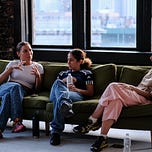
29SEPT2024 Jeanette Bisschops in conversation with writer and director David Velasco & performer and director Nile Harris, discussing the Sarah Michelson monograph from MoMa's Modern Dance series.
Before being editor in chief of Artforum from 2017 to 2023, David Velasco was the creator of and series editor for "Modern Dance," a series of monographs published by the Museum of Modern Art, exploring dance makers in the twenty-first century, which has produced three books: Sarah Michelson (ed. David Velasco), Ralph Lemon (ed. Thomas T. Jean Lax), and Boris Charmatz (ed. Ana Janevski).
Selected quote by 99 Canal’s team:
“I remember this trip in Switzerland. It's a very potent memory of being in Switzerland for Art Basel, for my job. And I hated Art Basel—it was just market, pure market. Sarah was premiering Dover Beach at The Kitchen, and I used frequent flyer miles to fly back to catch the premiere. Then I was in New York for 18 hours, and I flew back to Basel to do the rest of the fair. But I cant miss this performance. This is actually what matters. It’s not tied to the market; it’s just done for the love.
I mean, this is the messed-up and also beautiful thing about dance, poetry, and a lot of forms that have no market—if you’re in it, you’re really not in it to make any money. So that keeps it clean in this way that’s also brutal. In contrast to what I was doing with the art market at the time, I felt like I had to be here. This is what matters. And there was something to that, I think, that connected to what it was about, that was so different from the world I was in, that I was being paid to do.”
David Velasco
Jeanette Bisschops Well, hi everyone! I'm Jeanette Bisschops. I'm an independent curator, and I've been working on a project called Performance Talks, and in addition, I've been hosting book clubs because I wanted to, as an independent curator and not having a space to work from, bring people together from the dance world and the visual art world and whoever is interested in performance and dance to just, like, gather and talk about performance. So I've been interviewing people like artists, dancers, choreographers, writers, curators, estate directors, mainly about the afterlives of performance. Coming from an institutional background, I felt like the visual art world still doesn't really have a lot of discourse around how to talk about performance, how to integrate it in institutions or not, and just kind of the many ways that performance can live on, how to historicize performance, etc.
I spoke to David about his modern dance series publication. A series of monographs on contemporary choreographers that was published by MoMA. And this book, one of the three ( the other two are on Ralph Lemon and Boris Charmatz) really stood out to me, and I had such a lovely conversation with David about this, and I wanted to open up this conversation with other people... So please also chime in, It's not just us talking. additionally, Nile and I know each other not even that long, but we had a really lovely studio visit, and we were kind of geeking out about the book.
The interesting thing is, both of us have not seen Sarah's work live before. I was introduced to it by David, and I was allowed to see some footage in an archive somewhere, and Nile..
Nile Harris Sadly unseen, no archival footage, just essays and vibes is all I know.
Jeanette Bisschops And David, obviously is very well known with her work.
So….David. I first want to have you introduce yourself a bit. Because I know you mostly from your former role as editor in chief at Art Forum. And I was only recently introduced to your writing. And I was kind of creepy in looking at your Instagram, and was like ‘who is David?’ I started scrolling back, and I saw some photos of you dancing as a boy, and I was like, Okay, it's like he's a dancer himself! I was just very curious why he was so drawn to dance as a writer. And I saw this interview with you about your early days as a dancer in New York, and we spoke a bit about it.
I think it would be nice as an introduction, if you can talk a bit about, like, what made you so interested in in writing about dance, and kind of how you started writing about dance, maybe also in your early days at Art Forum, where you were, like, kind of covering events first, and kind of moved from there?
David Velasco Yeah… I mean, there's a lot there. I moved to New York in 2002 and I had no idea what I was doing, but I went out every night when I was here. I went out to clubs, it was just the thing that I did. And I loved to dance. I couldn't speak to exactly why that is, but yeah, it's always been very much a part of what I've done socially. And I had a friend, have a friend, Kim Brandt, who's a choreographer, who also was here at that time, and she saw me, while I was dancing at clubs, and was like, I want to put you in my dances. So she was making dances at the time. The funny thing is, I'm, like, a very good club dancer, but it doesn't translate to a stage at all.
Jeanette Bisschops What kind of dances was she making?
David Velasco Downtown dance. Which is, like, this funny category that I try to unpack in the book, whatever that is. So it was, you know, it's a mix of different kinds of flavors of modern like, the things that she studied in school, from Graham to Cunningham to Brown to like, you know, what have you….
mixed with? Uh, all the other stuff going on. But that's the thing, every dance, as I try to go into in the book, like Balanchine was also doing this, like Cunningham's also doing this. Everybody's mixing these different kinds of forms. That's how you get the invention of new forms. So it's not like it was novel to be doing that. It's not like modern or postmodern or anything. Anyways, she saw me dancing, tried to put me on stage. I was not gifted in that way, but I got to see inside of the making of dances a lot over many different years with her. And this is before I started writing about art. It was before I was in the art world. In fact, I think the first thing I wrote ever was for movement Research Journal, and it was a terrible piece that I hope has disappeared, but it was about improvising and trying to figure out how to do improvisation in writing and in dance in a way that would be married.
So I guess that was an early iteration of all of this. But the formation of this book came out of me seeing Sarah, and we have to say that Sarah's in the room, hiding over there, so I'm sure that she'll… well, we’ll call on her maybe at some point, or she'll interrupt.
Hi, Sarah.
But my friend Kim took me in 2005 to see this piece called daylight that she did at Performance Space, New York, which was then called PS122, and I was completely devastated by this piece. I was just like, thrown out of my body, and I went the next day, and I bought another ticket to see it the next night, and I bought another ticket to see it the next night as well. I was obsessed immediately, and then from then on, I just had to see everything she did. And there was something about that, where as I grew as a writer and figured out what I was doing in these other realms, I kept returning to, how can I make an offering to this work that is completely captivating me? How can I explain why I'm so
turned by it?
And then, like that, it just unspooled into this project, which has, like this material iteration, which is this very strange book. Actually, I think if anybody's read it..
Jeanette Bisschops Why does it feel strange to you?
David Velasco Well, it's strange. So this was part of, like a series Ralph Lemon and Boris Charmatz at MoMA, the idea was to do for… and I have to also give thanks to Kathy Halbreich, who is not here, but who is an incredible woman, incredible figure, who very much created the conditions and invitations for doing work like this. And Stuart Comer, who's also over there, who was leading the department that the book was housed in. So they made a home for it.
But I wanted to create monographs. I wanted to make, like scholarship that rose to the occasion of these incredible artists, like, in the visual art world you have… like, any fucking artist can get a monograph. You just get a gallery, and somebody will pay for a book. And like… you know, not anybody, but, like, a certain class of artists easily gets monographs. A lot of them are really shitty. They're not really thought through. They're basically spam for marketing these books.. but there is also a lot of quality stuff that comes out of it… But there wasn't that happening in the dance world. And I was like, there are these artists who are just some of the greatest artists I've ever seen, and there's not that level of attention, or that record for their work. And so like, what would it mean to try to do something like this? And the Sarah book was like… I mean, it's funny, because, okay, there are no images. This is the thing that's striking in the series, and also, I think in dance books in general, and there are no images for a lot of reasons, but primarily because Sarah and I had a very intense conversation around what images could be in the book and whether you could properly represent the book or represent the work with these images.
The images around Sarah's work, most of which have been taken by Paula Court, who's a really legendary performance photographer, are some of the most incredible images of dance ever made. They're exquisite images, and unlike anything you'll see. So I spent 100 hours probably building a database of these images, reaching out to institutions that weren't collected anymore. None of this was collected anywhere.
Jeanette Bisschops So she's also never published her work.
David Velasco Paula's never published her work either. So I was like, we're gonna have full color, beautiful, an illustrated book with lots of beautiful images. And then in one of the many conversations I had with Sarah about the book, Sarah was very resistant to the book, from the get go and one of the primary… and she can speak to this better than I can, but what I took from it was that she had very valid concerns around whether you could properly create a relationship between texts and images, without that relationship being a completely artificial one, and also deceptive to some extent, so we concluded that if I was to write about her performances, the text should stand on its own. Basically, she was like, if the text is good, it should stand on its own. And I fought her a lot on it. We had many ideas for how images might live in the book, in a way that felt sincere, one of which was flying to the place where we printed them, and sitting in the place and stuffing each book with a single photograph we would print out, you know, so each book would have a different photograph.. but you could get it, like, a collector's card or something. But all of that ended up being too expensive or too labor intensive, or just didn't really work. So in the end, we just did this kind of...I think, pretty punk thing of just not including any images.
Jeanette Bisschops Was there ever a moment that you were like, let's just not do this book, I'm giving up?
David Velasco mmmm no. I was like, I'm gonna do it, but pulled my hair out like many times in the making of it. It was definitely not an easy thing to do, but that was what the embattled meant, actually, I think was part of what created this crucible through which the book emerged as I think a cool object… it's weird to encounter it now! I haven't looked at it for years, so I picked it up recently, and I was rereading parts of it, and I was like, “Oh, this fucking slaps.”
(laughter)
Jeanette Bisschops Yeah. When we spoke, I read some parts to you, and you were like “oh, yeah, I haven't seen this writing in years..”
David Velasco But I'm so curious, I want to know what Nile’s relationship to it is and how you encountered it? Like, how did it come to you?
Nile Harris I found it in a used bookstore at Light Industry. I moved to New York in 2017 and had this unnerving feeling that I had just missed something? Or I feel it was like “we used to have fun. We used to make dances” and now we are here, and it’s 2017 into 2020 and like covid happened and all other things. But I had this feeling that there was an artistic conversation, that I was just catching the tail end of. So I was perpetually going on this fact finding mission of trying to figure out what I had just missed…
David Velasco That's what I felt like.
Nile Harris Yeah, I guess everyone feels that way moving to New York. There's a conversation happening, and everyone's telling you it was better before, and then you have to perpetually be like, it used to be better! So that's how I felt. So in that sense, you know, just like a performance nerd, I was trying to figure out all that I could. And I was first exposed to Sarah's work through the Walker Art Museum. Phillip Bither has an interview series with all of the commissioned artists. And I just like, you know, have watched every single one, like, pretty devotedly. I cite that as, like, such a big part of my dance and performance education. And then came across, I think three interviews with Sarah over the three commissions that she did at the Walker, and that was when I was first exposed to her work. So that's how I became slightly aware. And then, yeah, coming across this book at Light Industry, I guess, like, as y'all spoke to, the lack of images is very striking to know that there's a book about choreography or performance that's just, you know, text.
And then reading the book, I just fell in love with some of the descriptions of the work and some of the tales from her collaborators. And since then, I always cited Sarah jokingly as, like, “my favorite artist whose work I've never seen”. But this book was just really big…. an introduction to what can't be described, which is, these live experiences.
David Velasco It’s really interesting to hear. I mean, so a lot of the book, if you haven't read it, is about audience and about who you make work for, essentially..
There's a really extended argument about the audience as itself. I mean, it seems so obvious, but if you don't have an audience that's really paying attention, whose expectations you can be upending, then the work is not going to evolve. If it's just for, like, quote, unquote, “YOU” or something. You're not going to go anywhere. You have to constantly have, even if it's imaginary, some kind of interlocutor that's forcing you to redo what you're doing.
So when I made this, I didn't really know who the audience was. For me, the audience was the people this was dedicated to… It was just my partners at the time, my friend Kim, Sarah, and…I hope that there will be an audience later, but I could’t be sure… Because again, there wasn't a launch event, it didn't really have a life that I felt at the time. And I was like, well, maybe it'll have an audience later, so it's cool. You create the conditions, and maybe somebody picks it up, and then you're writing to that person you don't know yet. And it's very sweet and gratifying to know that it hit with you.
Nile Harris Yeah, audience, community, I was just looking on page 80. This quote, you cite Sarah saying “The work is only important because of its relationship to its viewership and to the discursive relationship that you have with who matters to you.” And then you later comment that “the worth of the work emerges from their place in a super specific web of people. It’s not for just anyone, but for those who matter, the devoted.” Going back to Sarah's Devotion series, and I feel that really speaks to what you're saying about audience and community, and the real importance of that. I call 99 Canal the Dimes Square Arts Center, in this way, this weird place dedicated to performance and film, but the cool kids spot, and in that way, like the people who have gathered here today, I feel like it's also another reflection of the devoted people who are, like, just devoted to performance and art, and in that way, I feel like you speak to that really clearly, and this collection of essays and speaking in reflection to Sarah's work in a way means a lot to me.
David Velasco So the body of work that this really pivots around is this series that Sarah did called devotion, starting in 2012 I believe. And the word devotion, what that's about, is part of what I'm trying to unpack. And it is like, what does it even mean to be devoted? How does one become a devoted audience? What is the quality of devotion like? How does that change the work and to do that also, I mean, there are other essays in the book, and I was trying to get other voices of her community in there, because these are the devoted. I want their voices in there too. It can't just be mine. And, very notably, Ralph Lemon, who's such an incredible artist and writer.
Jeanette Bisschops Great writer!
David Velasco And actually you said that there was a relationship between B side, this piece that he wrote in the book, and minor b, this piece that you made. And I'd be curious to hear about that!
Jeanette Bisschops yeah, the piece that you showed at The Shed this summer,
Nile Harris Yeah, this August. I made a play called minor B, and I read this essay maybe, like, three years ago, but I completely just restaged this essay without subconsciously knowing it. In a way, like, when something is so white, it becomes black.
Jeanette Bisschops Can you speak a bit more about what, what that means. Ralph lemon,
and what he says.
Nile Harris This is so strange, talking about this with Sarah in the room, a person who knows about this much more than my uninformed self.
Jeanette Bisschops As a bit of backstory, Ralph Lemon was invited at MoMA to curate a series of performances with other choreographers called Some sweet days.
Nile Harris Yeah, and he shares in the essay that there was a secret prompt to all of the participants to respond to… Yeah, maybe the prompt was black music? or maybe it was specifically the blues? I don't remember, but somewhere in there, he's so committed to quotations right now, I don't know why. Yeah, he just goes through this whole rant around, you know, to every B side there's an A side, or to every A side there's a B side. And like, speaking about Black fugitivity, and citing a lineage of artists who are engaged in fugitive practice and citing that as blackness. And then goes on to compare Sarah to that of the black radical tradition, the whitest choreography I've ever seen, a new black, he says, a Brit with soul, and in that way, like, yeah… I was making this play called minor b. The actual plot of it has, like, nothing to do with this at all. But I was thinking about the notion of the B side, the sort of the negative of a thing, like, if there's a positive, what is the negative? And then also thinking about, as I said, like my love letter to this community and tradition of artistry that I only know about through word of mouth, and, like, you know, archives, but I'm not like an archival nerd, like going through archives looking for shit. It's just like, what gets to me, and like what I hear about through hearsay. And it's just like a love letter to what I call the white downtown avant garde of the early 2000s because I just felt like I have this convinced notion that it was better then…. I have no idea why I'm really convinced about this, and maybe some people in the room were there, and could be like, “No, it was broken!” or “Our artist fees were $100, it was bad.” But it just seems like the work was being made and it looked like a really fun time. People were touring works like, whoa, that's crazy. Yeah.
So in that way, I just felt like I was trying to pay homage to that by casting this actor, Jim Fletcher, who has also appeared in Sarah's work and like, notably in the premiere of the devotion works at The Kitchen, playing a canonical male figure, playing Adam. I'm recasting him as, like, you know, my love interest, who's actually a board member at the Shed. But then also, that's also a Sarah reference in its way of like, you know, folding in the sort of, like institutional staff into the frame of the thing, of the critique, like we are all players in this thing. Like no one is spared. And, and then, more specifically, a portrait that I commissioned of Jim that is very much like, again, subconscious, but I think the portrait was more conscious, but maybe, like a reference to daylight somewhere that Sarah uses portraiture a lot in her work, and like, large portraits of curatorial staff, dancers and things like that.
So over the course of the year, I guess I got to know Sarah more as a friend. The first time Sarah saw my work was at Judson, like, a year and a half ago, and I went on this long tirade about listing like a little white artist. And I was just like. Sarah Michelson, I was like, I don't know why I put you off to the nature theater of Oklahoma. I was like, natural theater Oklahoma, you're dying. Sarah Michelson, you're dying, and I'm so alive. I am so much alive. Beth Gill, you're dying, and I'm so much alive, Sarah. I said, Sarah, I love you, and you're dying, and I am so much alive. And I'm so much alive and and then she was there that night, and, and that was, like, the first evening we met. But I don't know why I went on that tangent…
David Velasco That's a great tangent. I was watching the video of minor b this morning, because I wasn't there for the actual performance. So, like a lot of these things, you catch it in these other afterlives, many of which are completely just like terrible versions,
Nile Harris a shell of what the actual thing is.
David Velasco But if you go in knowing that it's a shell, you can kind of take out the stuff that you need. But I saw the portrait of Jim Fletcher on the wall, and I was like, wait, this is daylight. I was like, what? Because in daylight, each of the dancers has a portrait painted by Claude Wampler, this artist that, yeah, it's just, like, a stunning backdrop. And I was like… Oh, you haven't seen the work, but you got it from the text, I think that's so cool. It was just like,
Nile Harris I'm curious what Sarah feels about that. But you actually speak about the works pretty objectively. Subjectively to you, but like, maybe for other readers, you're quite objective. Something that stood out in my memory the most when I first read it, and I always cite it many, many times in conversations, how you describe Shadow Man at the Kitchen..
And I don't know why I just have such a strong image in my head. It's only a paragraph of text that you wrote around Sarah flipping the audience, the audiences are facing the door, and then the closing gesture of the girls getting into the white limousine, driving east. And that being very important, because the next part, PART 2, was on the east side of town, and like that limousine image sticks in my head, as if I saw that work, but I completely didn't.
And that's why I think it's so beautiful. And it feels like the lack of images in the book, I didn't know the story behind the why the lack of images, but it was clearly quite intentional to me that the words and the descriptions and the sort of associations you can draw up from the text and the hearsay of it all will be more potent than any image could ever try to approximate about this canon of work.
David Velasco It's so cool to hear that. It's cool to hear that it hits because it was so intentional. I was talking with my friend Hannah, who's a beautiful writer, sitting over there, about, basically thick description. And about, like, the power of thick description, like, how, if you describe something properly. You don't even necessarily need to theorize or say something else about it, in the way that, yeah, in the way you articulate it. It can actually just say everything you need to say, if, like, you do it right. And I was really dedicated to getting that description right, just enough information, the right details to like, give you something that approximately is the after image I had in my head of it, which came a lot out of event writing, basically, like, which we talked about Jeanette and I. There was a period of my life where I was basically a party reporter, and it was actually an incredibly useful experience, because I had to, like, describe artists and events, like the night after and give a flair, you know? I had to give people a feeling of what it was. And that was definitely what allowed me to do some of the descriptions that I was doing of the work. And it's something that also just doesn't exist in a lot of dance writing. A lot of this book is me being like, fuck you to a lot of other dance writing. I was like, Why do I not get really crisp descriptions of what's going on that are also informed by, like, the history of these movements and like, I was just like, I want to see this, and I also want to be able to connect it to those ideas.
So it was me being like, how do I do this thing I just don't see in other places? But it starts with how do I actually just describe what the hell I've experienced for somebody to pick up on later. And I didn't know if it was doing that, but it did that, which seems like for you definitely did.
Nile Harris Why does dance writing suck right now so badly?
David Velasco It's not just now. I don't read enough dance writing now to know if it sucks or not.
Nile Harris Okay, I thought this book was the only one I know. Well, we have the PJ Of course, which is doing that work, but like routine… and yes, like essays about but like routine, sort of like our
Audience Do distributing art publishers release or promote books about dance? No, like, is that a mechanism by which our texts get distributed all over the world and in the eyes of like, cultural consumers and curatorial blah, blah, blah? yeah, and does dance fall out of that? for sure, but I dont think you can make statements that all dance writing sucks right now.
Nile Harris I mean, I think what I was actually referring to is not dance writing, but, like,
Audience every dance text begins with some cradling to how it's so hard to write about techniques
Nile Harris and maybe I was thinking more specifically around, like, for lack of press coverage, or better routine coverage of performances that are happening in real time, less so, critical writing about dance. There's so many scholars who are definitely doing that work.
David Velasco But it takes a lot of work, takes a lot of work, a lot of the audiences for this work. I mean, so much of the problem with a lot of academic writing about dance is that the audiences are not necessarily…. I mean, okay, so the weird thing about this is that I came out of an academic realm, but then I also became a reporter, basically. So I was marrying these two things that had in my head both the scholarly realm and the like, like daily journalist realm. And I was like, Okay, there's a way to bring these two things together. But if you're siloed, if you're just speaking to the newspaper audience, or if you're just speaking to the academic audience, you are not getting the full flavor of what is possible with writing about this stuff, essentially. So I think that's what I would say about why dance writing sucks? It's just specific. It's just specific for its audience. And a lot of the time it's not trying to invent a new audience for what it's doing. I think… maybe if I was going to respond to your question in a serious way.
Jeanette Bisschops But you're writing about a time based thing. You're writing about, you know, something that's happening over time. If you have a visual art background, you're not taught. You know, I also spoke to Roselee Goldberg, who famously also always says this, like, we're not really taught to think about art as a time based thing. So I feel like a lot of writers also lean on theory, or on references that make it very hard to access a work.
If you don't catch certain reference says, like, for me too, like, this was such a good introduction because I felt like I wasn't … how do you say that? How do you really take someone into the work without leaning on those references, not just not leaning on images. And I saw the Ralph Lemon book, actually, the other one from that series, and ther are a lot of images in that. So it's a very, very different book. I was also wondering, because you invited other writers as well. And not everyone has a background as a writer, I think someone danced with Sarah. Yeah.
Jeanette Bisschops How did you choose the other writers?
David Velasco I wanted one person essentially from different so, again, one of the things that's so fascinating about Sarah's work is that it considers every element, every detail of the place it touched, every detail of the institution it touched. So it's keeping everything in the frame. And I wanted to get somebody who danced with Sarah. So I got Greg Zuccolo. I wanted to get somebody who was a reporter, like a Times reporter, so I got Gia Kourlas. I wanted to get somebody who curated, so Debra Singer. Ralph Lemon, he was like a colleague, you know, I wanted to get a spectrum of people who had encountered the work at these different levels. But I also wanted a good writer. So, you know, Greg's a great writer. He's such a good writer. His piece kicks off the book, and it's just, bam! Ralph is such an incredible writer and so part of that was just who can actually write, which is, you know, something that I'm thinking about as an editor. It's not necessarily common to get people who can speak.
Well, I mean, good writing is basically honest writing, and so many people are taught to lie in writing. Basically, it's like this weird thing that you have to erase with people, and it's really hard to erase, but some people are better at being honest in their writing than others. And I chose people I thought could do that.
Jeanette Bisschops So what was the invitation like? Or cues?
David Velasco It was like hi… can you…(laughs) Some people, like Gia, write about stuff that I didn't see, stuff before I came around. So, I wanted them to write about things that were in their view, that I couldn't cover in my bigger essay that was doing this other kind of work. Yeah, that was pretty standard.
Nile Harris I have a super mundane question, how long did it take you to write this essay, “Split City”?
David Velasco That was probably written over the course of two years, I think. It started as as a piece in Art Forum.
Jeanette Bisschops When did you start writing it?
David Velasco I want to say 2014-2015. A short portion of it is this piece that was in Art Forum, and then I just expanded beyond that over the course of a year, year and a half. The whole book probably took 1000 hours or more. I was trying to, with Hannah earlier, go through all the folders I had. And I was like, Oh my God. I went in. I watched this video of Shadowman.
Nile Harris A video of what?
David Velasco I got a bootleg video of Shadowman. I ripped it from a DVD, because this was on DVD at the time, I then ported it to my phone, which in that moment was not easy. Then I would sit on the subway and every day I went to work, I would watch it again and again. Just to be like, wait, that gesture! I was like, how? And that was the thing. The scooping gesture that's happening at this particular moment, in minute 59. I I want to know how she made that decision! What were the conditions that made that decision? Can I fantasize this world in which I can understand that decision being made and how it relates to all these other decisions. Can I create this environment for getting a sense of the meaning of that gesture?
Jeanette Bisschops In that process, where you and Sarah talking about the work, or was it very much you and your experience?
David Velasco It was me, my experience. I don't think I was talking much with Sarah about these things. I did a conversation with Sarah early on, but like, we weren’t… And Sarah's pretty private about a lot of these things, so even if I had specific questions about why something was there or not, I don't think that she would give me much to work with. So yeah, it was just a lot of detective work and total fantasizing.
I mean, I don’t actually pretend that this is what the work is. This is very much my deeply informed, but, very partial take on what Sarah's work meant in this moment. And there's a lot of things that are still very unexplored, or that you get a taste of. The question of blackness in the work that Ralph Lemon raises, and which also, interestingly, in an easter egg, Jeremy O. Harris raises in the very last couple pages of the book. There's a conversation that ends with. It's just Jeremy, but he asks: Ralph Lemon says, “Your work is black.” And what does that mean? And Sarah's like, um, I don't know. You know, it's a really interesting question that's in there. Ralph is basically, it's black because I say so, and because it's oppositional, and because it's born of this lower class, Mancunian, British thing that resembles something that I recognize more than lower class American whiteness or something. There's a lot of class stuff in the book that gets tied in. I can talk about class, but race gets put in this in a smaller way that would be really interesting to have unpacked and there's a whole other book that could be done about that.
Nile Harris Did you always have such a deep knowledge of modern dance history, or was that something that formed in research for this book? Because you’re bringing it to Balanchine and Dunham and all these folks, and I mean, I don't have that particular lineage of knowledge, and it's such a part of Sarah's work, these dance histories and legacies. Was that a part of your knowledge set?
David Velasco I didn't study any of this stuff. But I also didn't study art. You can learn anything, you know, it's just, like, you just go read a bunch of stuff.
Jeanette Bisschops Yeah, how? It's interesting. I arrived here five years ago. I very much had a similar feeling. I grew up in the rural south of the Netherlands. I very much had no access to this world. You come in and you're like, how do I catch up? You know, and a lot of it is maybe hidden in an archive, or maybe you get it from meeting someone at a party and speaking about it. But yeah, how do you get access to this information? How do you inform yourself to this history? Because there isn’t that much.
David Velasco You go to stuff like this. You read books, you see a lot. You just go in. I don't know, you commit to the actual learning and think you can do it, and then you start doing it. I mean, I'm not a dance scholar either. The stuff that I know about dance is also very partial. I know about Balanchine because I read a lot about Balanchine, I picked up lots of biographies. I read Jennifer Homans, whose book I hated but that it was very helpful. I dated a performance artist who I could just talk to ad nauseam about it. I made friends with dancers. You talk to people, you read, you watch. It's just like you learn anything. It's the best way. Learning is much better than school in that way. But yeah, I didn’t know anything about dance, and then I learned a lot. I don't know if I could teach a class on it. Maybe I could teach a class on it, but I don't know if it would be the right class.
Jeanette Bisschops I really want to invite people also to ask questions or make remarks. Go ahead.
Audience I have a question. David, you said you saw this performance three times, and I wonder if you can characterize what you saw or what it felt like. The first time I saw Pina Bausch, you feel that there’s something called vernacular in dance that I'd never seen before. Can you characterize these images?
David Velasco I saw a closeness among the dancers. It was these four dancers—Mike Iveson, Greg Ziglo, Parker Lutz, and Sarah—at Performance Space. And they were so… It’s not that they were in sync in an actual literal way, but there was a rhythm to how their bodies were connecting that I was like, ugh. They were like soak floats. There was something about the quality of that closeness, and how they were moving on stage together. It was weird—it was kind of this middle-class, earnest, not earnest. It was all these weird dance moves juxtaposed with a soundtrack that included mixes of... It starts off, actually, with the most beautiful beginning ever—she has a live band playing Baker Street by Jery Rafferty and they play it twice in a row. The band is hidden beneath these risers, I believe, and the first 15 minutes of the dance is this live kind of good-but-not-good live version of Baker Street. And the dancers come out and do this dance with crazy lighting, and you're like, what is happening? It's beautiful, but wrong. And it’s held together by the way you can see that these people are family in this way. It’s a family that's… I don’t know, you can just tell there’s something maybe about to break up, it’s on this particular part of its journey. And I just—I fell in love with them, I fell in love with it. I was attached to what was happening. And yeah, I saw that two more times, and then I became religiously devoted. I would fly if Sarah was doing something at the Walker, I would go there and see everything. I would see it multiple nights.
I remember this trip in Switzerland. It's a very potent memory of being in Switzerland for Art Basel, for my job. And I hated Art Basel—it was just market, pure market. Sarah was premiering Dover Beach at The Kitchen, and I used frequent flyer miles to fly back to catch the premiere. Then I was in New York for 18 hours, and I flew back to Basel to do the rest of the fair. But I cant miss this performance. This is actually what matters. It’s not tied to the market; it’s just done for the love.
I mean, this is the messed-up and also beautiful thing about dance, poetry, and a lot of forms that have no market—if you’re in it, you’re really not in it to make any money. So that keeps it clean in this way that’s also brutal. In contrast to what I was doing with the art market at the time, I felt like I had to be here. This is what matters. And there was something to that, I think, that connected to what it was about, that was so different from the world I was in, that I was being paid to do.
Nile Harris I have a question for the room. We can talk about the book, which is talking about the work, but—I would never put Sarah on the spot—but I know I see at least three folks in the room.
David Velasco Why not?
Nile Harris Respect, respect for your elders! I do see at least three folks in the room who have danced for or collaborated with Sarah. If you’re interested, I’d love to hear an anecdote, or any thoughts or feelings around what it felt like or meant to you to collaborate with Sarah, If you feel comfortable doing so. Putting you very much on the spot, John and Marih. I feel we can opaquely talk about a book, but I want to get some source. Let’s get some source! I can read the essay. I know John did a really good somersault, but I need more!
David Velasco The first time I saw John was in this piece, Devotion, Devotion Study of God—what was it? Devotion, Study Number Four? at the Whitney. He came out on stage, and I was like, What the fuck? Who is this? He’s such a fucking genius mover. And then he was in this other piece, Tournamento, and I thought, he’s captivating. And, yeah, I don’t know. What was it like? Why did you get into Sarah’s work? I am going to put you on the spot.
Audience I thought that while we’re gathering today to talk about the book, I’m here to show up and tune into that. But I don’t really feel super available to talk about all that. I think that’s probably some combination of, like, my own stuff, and my relationship with Sarah. I don’t know. Such an important part of the work, if I can speak on behalf of the works that I was a part of, was being there and witnessing them live. I think that has a relationship to the image question around the book. And, yeah, I don’t know, I don’t feel super available.
Nile Harris Well, you’ve already shared a lot.
Audience Well yeah, but I haven’t been talking about what it was like.
Jeanette Bisschops What was it like to read the book? Did you read the book?
Nile Harris Oh, that’s a better question.
Audience I mean, it was fun to read. Anybody who's involved in any process with any artist has limited access to what the history of the body of work was before they joined—that’s pretty universal. And so, through the book, to get more context, hear more stories, and points of view on aspects of the history or body of work that happened before I came into it was valuable and interesting.
Nile Harris Thank you, John.
David Velasco Can I ask Mariah how you first encountered Sarah's work?
Audience I first encountered Sarah’s work actually when I saw Dover Beach. I I don’t remember what year was that Sarah, was that like 2010?
Sarah Michelson Yeah, 2010.
Audience I didn’t even know Sarah yet. I had just moved as well, and I was somehow friends with Tragil. I don’t know, I was editing, or whatever I was doing with Performance Journal stuff with Tragil. Anyway, he was like, “You have to go see Sarah, I’m out of town. You have to go.” So I tried to go, but there were no tickets because it was sold out. I remember I got to The Kitchen really early so I could make sure I got in. I think I got there two hours before or something crazy—they were still rehearsing, and you could hear the music. I was just waiting in the lobby. And then I saw Sarah in a few other contexts.
I was really into the work because I thought it was a kind of feminist takedown on ballet in a very specific way that was interesting and deconstructing that history. Like another system of semiotics, major artists like Forsythe or someone who’ve also taken on the history of ballet and deconstructed it, but from other points of view. I was riveted by the work, but I don’t think I ever talked to Sarah until we got into the argument around questions of authorship. Also, because of Fragil. IN one of Judy’s Danspace platform things—when Fragil did Certain Difficulties, Certain Joys in, I don’t know, 2011 or 2012. And, yeah, and then, I don’t even want to talk. I have no comment. I don’t ever speak publicly about what it was like.
David Velasco There are two things there. I just want to pick up on the experience of going to a sold-out performance. This is one reason I wanted to do the book because Sarah, and to some degree Ralph, especially Sarah, doesn’t do repertory. So it’s like, you’re either in New York when it’s happening and there for the week or two it runs, and you manage to get a ticket, or you just never see it. There’s no record, nothing. And I was like, whatever, that’s fine with Sarah, but it felt totally unfair to me. So it was like, there has to be something there to live on, if nothing else than just for my own gratification.
But also, encountering Sarah’s work, all these other things, it’s about a community. It’s about showing up to things—you go to so many events. I mean, I go out much less than I did before the pandemic; basically, I haven’t been a part of the world in that way since then.
So I'm actually still curious about the texture of the dance world now. It feels to me like there are really cool people making things that I’m only tuning into, but you have to go to events, you have to be in conversation, you have to meet people, have arguments. That’s how you do this. It’s not just showing up at BAM and being like, "Look, this person made this thing." The beating heart of it is people coming together in small rooms, and often having really intense polarizations around specific questions.
Nile Harris That’s something I’ve been making peace with more recently—this sort of “those that know, know, and those that don’t, don’t,” and just being okay with that. I used to call it an inside joke, like my work always has an inside joke in it. I’m not going to explain myself, but if you get the, you get the thing. Jessica was talking to me last night about it, saying, “I love Jim Fletcher,” she knew what the Jim Fletcher reference was about, but half the room probably didn’t. And I’m not going to explain that, but I know what it meant to me, and some people know. And that’s just, I think, what makes it better than if it were trying to make it universal, or trying to speak to a global, universal audience. It’s for the people in the room, for those in New York those two weeks, for the devoted audience or community members, and from different aspects of the field. That sort of insularity is something I find really comforting and fun about it all but I used to see it as maybe like a limitation.
David Velasco Yeah, and I think there’s this idea that that Easter egg thing does create an inside-outside feeling, but they also add something. Those inside jokes, even if you’re not in the know, are invested with a particular charm that emanates something for people not in the know. Even if they’re like, “Why don’t I understand that? That seems confusing,” there’s something charismatic about that gesture that’s hard to put a finger on about that “if you know, you know” quality, and it will attract people, which I think is an argument for authorizing yourself to do that basically.
Jeanette Bisschops Because there are no images in this book, it makes it such a special book. Sarah doesn’t allow for any video or whatever to circulate around a work, which adds a certain mythology. But what I’m seeing too maybe in the younger generation of artists, is a sense that they don’t feel in control of their image or the images that are made. How do you feel about that? Do you feel you can, or want to, take control of that? How does that affect your work?
Nile Harris Yeah, it’s super mediated and conscientious. I’m on Team “not gonna ignore” the media aspect of the afterlife of the performances that I make—that’s a part of it. So I embrace it, but you will not find any full works of mine on public Vimeo. That feels weird. There are some clips, because people have to engage somehow, and so much of how I’ve understood the ecology is that you have to share the work somehow, so the work can proliferate somehow. So for me, sharing some videos and images helps that. But it also freaks me out that every public program you do at any organization has images and a record that’s just there forever. And after 10 years, you end up with a wealth of media that you didn’t author or, you consented to it, yes, but you’re on that nonprofit’s brochure for five years minimum. And you just have to be like, “Okay, that’s just a part of it.” So, not my fave, but I understand the purpose that it serves and helping these organizations proliferate their mission and do the things that they need to do. I don’t have disdain for it, but I try to be conscientious about what I share and what I don’t share. But this is badass. I’d love to be like “yeah, no images,” but if I ever did a monograph, I’d have some images. There’s some images that I like, that I’d want shared. So that’s where I stand.
David Velasco What would your ideal monograph look like?
Nile Harris Oh, my God. Yeah, you know, thoughtful essays by people who are in the room, and then just a couple of images. I feel like for each show I have, there are three images that I really, really love.
David Velasco Who takes the pictures?
Nile Harris It’s whoever the theater hires. I don’t have continuity there, but a lot of the work has been photographed by Maria Baranova, who I think for our generation, she’s like THE performance photographer and documenter of so many artists. Maria Baranova does really great work and also has a beautiful portrait series, ‘Faces of the Downtown’, where she shoots downtown artists in medium format that’s really beautiful of dancers and choreographers. So….I’ll have to work towards having a licensing agreements with Ms. Baranova for this forthcoming monograph!
But that's another weird thing about documentation—like, who owns it, who doesn’t own it, and this strange dynamic where adding more refractions to the work means it’s further out of your hands in terms of ownership and things like that. I don’t own the licensing to those images. I don’t have external use of the images for perpetuity, or etc., etc., etc. But if we're talking about gelatin prints of the thing, I don't own that. But, you know, these images that are clearly of me, composed by me, and made by me—I don't have full ownership. I have a whole other rant about photography, and I'm not a fan, y'all, but I'll talk about that for another talk. I just have really deep photographer trauma.
But yeah, there will be images. I mean, it’ll just be a monograph, like any other monograph, you know—a badass introduction by someone who’s really smart and can make my nonsensical decisions sound like part of a well-thought-out lineage. I don't know who that person is, though.
Jeanette Bisschops Someone like David?
Nile Harris Maybe!
Audience I have a question about deterioration and questions around how to historicize things that disappear and ar time-based art, which are really hard to put into formats of representation. Dance is just hard to see, even though it's constantly representing all sorts of things in ways that are kind of beyond language all the time. So I guess, to me, I haven’t read the book. I really haven’t. I haven't read Ralph's book either. I've always wanted to, but they need to even out their gender situation there. You have three men starring and shining anyway, but that’s beside the point. I want to say that I think it isn’t a monograph. I guess that’s an important distinction. I’d be curious to hear David and Sarah talk about this. I don’t know—do you perceive it as a monograph, or not?
I personally don’t perceive it as a monograph because it feels like an interruption of the kind of art market mechanisms where we make monographs based on the connoisseurship habit of compiling information into retrospectives and funneling artists' practices into products, leaving out collaborators. This happens in the name of the signature that emerges, much like in visual art. I’d just be curious how you all think about that in relation to the series. What’s its role in the game of the canon? Or the choreographer becoming artists, or visual artists? I feel like they’re not necessarily becoming that, but the machine is placing them in that space. We could look at some other mega artists who are really important, but the machine hasn’t placed them in the space of the visual art canon, whereas we can say that this has happened with Sarah and Ralph.
Maybe I’m saying something contentious by arguing that. So yeah, I’m curious how you all thought through that. Is it a monograph or not? If it isn't were you do it on purpose to run interference on this relationship between creation, value, and capital, vis-à-vis the mechanisms of the art market and all of its publication facilities that serve a kind of tool value and intellectual capital owned by certain individuals in the world—blah, blah, blah. Or is it perceived as a monograph and that’s all that matters because at the end of the day, perhaps that’s what it is.
David Velasco Yeah, I mean, it might be coy to say that it’s something a little more juicy than a monograph that’s disguised as a monograph, but it has the skeleton of it; it has a list of works, you know, with all the dancers, which did not exist before that. That was very important to me. You could pick up this book and say, “I want to know the history of Sarah's work up until this point,” just from what was shown where. It has a bibliography, and the armature is there. The actual texts are, I think, really unusual for the form, but probably also the monograph form can actually hold that. I would be maybe thinking too highly of myself to believe I was achieving something that bursts that. So, it’s a monograph, I think.
Say it. Tell me more.
Speakers:
David Velasco was editor in chief of Artforum from 2017 to 2023 and before that worked as an editor at the website for twelve years. In 2016 he was the creator of and series editor for “Modern Dance,” published by the Museum of Modern Art, which has produced three books: Sarah Michelson (ed. David Velasco), Ralph Lemon (ed. Thomas T. Jean Lax), and Boris Charmatz (ed. Ana Janevski). In October 2023 he was dismissed from the magazine after publishing an open letter from cultural workers calling for a ceasefire in Gaza. He lives in New York where he is at work on a book.
Nile Harris (b. 1995, Miami) is a performer and director of live works of art. Through performance, Harris creates immersive experiences that use the body on stage to manipulate one’s relationship to time and self-perception. He is currently part of the studio program at 99 Canal, recently presented minor b, a large-scale performance project at The Shed which premiered in August, 2024, and This house is not a home, which was presented earlier this year at the Abrons Arts Center in New York City.
Jeanette Bisschops is an independent Dutch curator, art critic and writer residing in New York. She was Curatorial Fellow at the New Museum, New York between 2019 and 2022 and served as Curatorial Assistant for Time-Based Media at the Stedelijk Museum Amsterdam between 2016-2019. She holds a Master’s in Psychology from Maastricht University and a Master’s in Art History from the University of Amsterdam.
About 99 Canal
99 CANAL is a project run by artists, for artists. As a 501(C)3 non-profit, our studio program and public program seek to amplify artist perspectives and promote equitable access to studio spaces and experimental art practices in the heart of Chinatown, New York City.
With a strong emphasis on film-based media and performance, our public program actively supports experimental practices while offering our local audience unique opportunities for engagement through participation and long-term reflection.
As an artist-run space, we intend to make 99 Canal a hub where impactful forms of art are nurtured, presenting ambitious projects outside of current New York City canons. The public programme is currently funded by our close community, and is access free to the public.
Website
https://99canal.net/#


